At Sun*, we invest continuously in AI-driven development and modern engineering practices — helping our clients accelerate delivery, reduce operational friction and maintain visibility across the software lifecycle.
Through Sun* AI-Driven Development, we embed AI directly into the operational foundation of how software gets built – transforming the way project knowledge is captured, structured and shared across distributed teams.
That investment was shaped by a problem we kept seeing in real delivery environments: critical decisions buried in Slack threads, estimation data lost in message history, project context locked inside individual memory.
When communication stays fragmented, AI inherits the same dysfunction – producing outputs that are hard to align, validate, and act on at scale.
Sun* Nereus closes that gap. As the communication intelligence layer inside Sun* AI-Driven Development, Nereus turns everyday project conversations into structured, actionable intelligence – reducing manual coordination, accelerating delivery cycles, and keeping every stakeholder aligned from kickoff to launch.
Communication Is Where Project Intelligence Gets Left Behind
According to PMI’s Pulse of the Profession 2024, 60% of project failures are attributed to communication breakdowns – making it the leading cause of failure ahead of technical issues.
The most recent 2026 edition of that same report found that misalignment drove nearly twice as many missed deadlines in 2026 as it did in 2025 and that communication volume is up while clarity is down.
And yet, for most software delivery teams, communication infrastructure has not meaningfully changed in a decade. Teams talk constantly. Organizations retain almost nothing.
Sprint decisions get made in Slack threads. Estimation agreements live in a reply buried three days back. Context that took a senior engineer weeks to accumulate disappears when they rotate off the project. Stakeholders wait for updates that should have been instant.
The root cause is not that teams communicate poorly. It is that no system sits between the communication layer and the people who need its intelligence.
Sun* Nereus is built to close that gap.
The Gap Between What Teams Communicate And What Organizations Retain
Project teams today are not communication-poor. If anything, the opposite is true. Slack channels generate hundreds of messages a day. Estimation discussions, architectural decisions, blocker escalations, progress updates – all of it flows through the same unstructured stream.
The problem is that nothing structured catches it on the other side.
When a new engineer starts mid-sprint, they lack a streamlined way to catch up on previous decisions and their rationales. Consequently, project managers are forced to manually sift through days of conversation threads to build status reports, and delivery team members must interrupt their primary work to generate progress updates for client stakeholders across various time zones.
These are not edge cases. They are the default experience of software delivery teams operating across roles, organizations, and time zones. And they compound in ways that are difficult to see until velocity drops or a miscommunication reaches the client at the wrong moment.
AI project management communication has no way to help if it is never given access to the communication layer where the real project intelligence lives.
Sun* Nereus – Ambient Intelligence for Project Communication
Sun* Nereus is an AI layer that sits inside Slack, continuously monitoring project channels, extracting structured intelligence from discussions, and delivering fluent, report-ready summaries on demand without interrupting the way teams already work.
The core idea is straightforward: project communication should not require manual synthesis.
Decisions, blockers, estimation data, and progress updates already exist inside every active Slack channel. Nereus makes that intelligence accessible, structured, and immediately usable – surfaced in clear, professional English within seconds, ready for any stakeholder, internal or client-side, to act on.
What makes Nereus different is not just what it captures, but how continuously that capture operates.
Most communication tools participate in isolated moments – a meeting summary here, a weekly digest there. Nereus is designed to participate continuously: ingesting message history, classifying channel context, extracting relevant intelligence, and surfacing it the moment it is needed.
The platform fits into the way project teams already work:
A Slack-native integration means zero workflow disruption – the bot operates silently in the background until called upon. Channel-type awareness means the system applies different intelligence logic to estimation channels and development channels, rather than treating all project communication as equivalent.
And on-demand reporting means the gap between what is being discussed and what stakeholders can see closes structurally, not through manual effort or scheduled reporting cycles.
Nereus gives every member of the team – regardless of seniority, regardless of when they joined, regardless of where they sit in the organization – the same complete, current picture of where the project stands.
What Changes For Your Organization
The impact of Nereus goes beyond internal efficiency. It fundamentally reshapes how project intelligence flows across the entire engagement, between delivery teams, our client and leadership on both sides.
Project Context Becomes Continuous, Not Compiled
In most software delivery environments, project visibility is still dependent on manual synthesis – project managers piecing together updates from scattered Slack threads, senior engineers repeatedly re-explaining historical decisions, and new team members spending days reconstructing context before they can contribute effectively.
Nereus changes that model by continuously transforming delivery conversations into structured, accessible project intelligence.
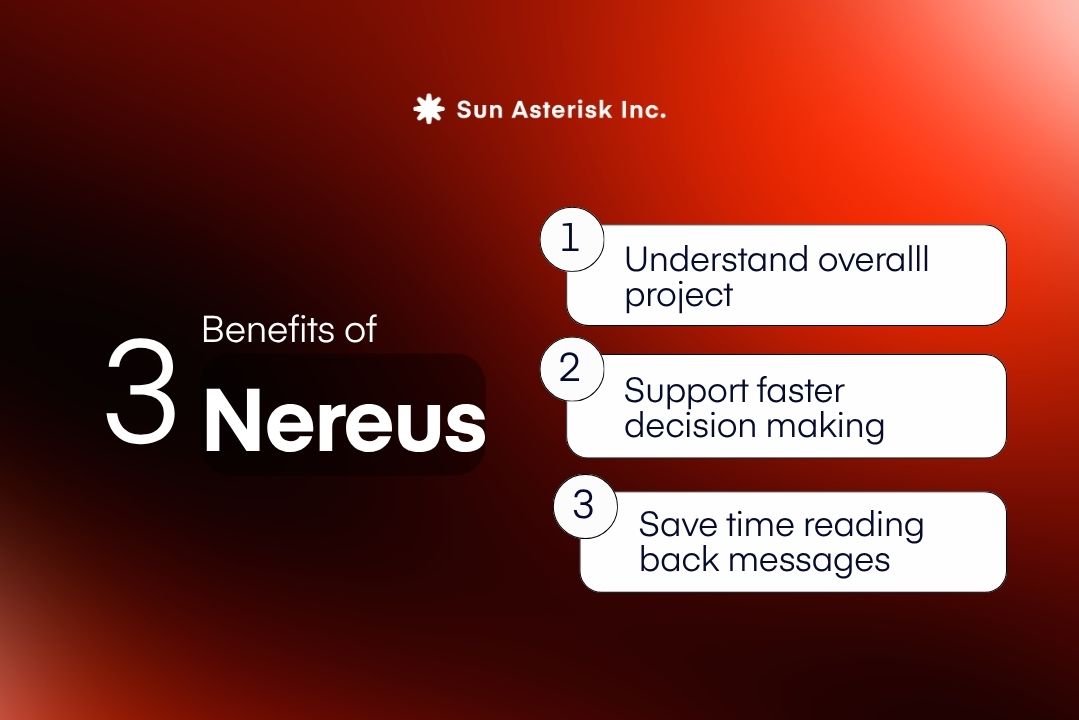
Because intelligence is captured directly from ongoing channel activity, project status remains continuously current rather than periodically compiled. Decisions, blockers, estimation context, and progress updates become immediately retrievable across the engagement – without requiring teams to stop delivery work to produce alignment manually.
For client stakeholders, this creates a fundamentally different delivery experience: visibility that reflects the real-time state of the project, not delayed reporting assembled retrospectively from fragmented discussions or standup summaries. This is the practical promise of AI project management communication – turning the channels where work actually happens into a continuous, structured source of project truth.
Reporting Reaches Every Stakeholder Without Delay
The visibility gap in outsourced software delivery is a persistent problem. Delivery teams carry critical project knowledge that client stakeholders can’t access when decisions need to be made. Reporting still depends on manual coordination – project managers consolidating Slack threads, engineers pausing delivery work to write updates, stakeholders receiving summaries that are already outdated.
Sun* Nereus eliminates that lag. It transforms ongoing engineering discussions into structured, stakeholder-ready intelligence – automatically, continuously, without adding coordination overhead.
Clients gain near real-time visibility into project progress, blockers, estimation discussions, and delivery decisions through clear summaries generated directly from active project communication. No waiting for the next status call. No chasing updates.
The impact goes beyond faster reporting. When both sides work from the same continuously updated source of project intelligence, communication gaps shrink, alignment accelerates, and trust compounds over the life of the engagement.
This matters most in distributed delivery environments – multiple teams, time zones, languages – where the cost of misalignment is highest and the tolerance for manual coordination is lowest. Nereus makes that environment manageable without making it someone’s full-time job – and represents what AI project management communication looks like when it is built around how delivery teams actually work.
Estimation Intelligence Becomes Traceable
Effort estimation is where delivery engagements are won or lost. It shapes client planning, resource allocation, scope control, and expectations from day one. Yet most estimation discussions still happen inside Slack threads where context fragments, assumptions get buried, and critical decisions become almost impossible to retrieve later.
Sun* Nereus fixes that by automatically extracting estimation intelligence from designated project channels and structuring it into clear, retrievable records. No more manually scrolling through discussion histories. No more depending on individual memory to reconstruct what was agreed and why.
Teams and stakeholders can quickly reference how estimates were formed, what assumptions underpinned them, and how scope evolved over time. Scope discussions become easier to validate. Alignment conversations move faster because the context is already structured and available when it’s needed.
Over time, this builds something harder to manufacture: delivery confidence. When the reasoning behind commitments is accessible and traceable throughout an engagement – not reconstructed after the fact – planning becomes more grounded, expectations stay better calibrated, and the relationship between delivery team and stakeholder operates on a clearer, more trusted foundation. That is the structural advantage AI project management communication delivers when it is applied where estimation decisions are actually made.
Organizational Knowledge Survives Team Changes
Team changes are inevitable in long-running engagements. Knowledge loss doesn’t have to be. Engineers join mid-project, responsibilities shift, delivery teams evolve. Every transition creates friction because critical project context lives in conversations, personal memory, and undocumented decisions that senior team members must manually re-explain each time.
Sun* Nereus reduces that dependency by continuously capturing and structuring project intelligence from ongoing communication. Decisions, blockers, scope discussions, and delivery context stay accessible across the full engagement so newly onboarded engineers can get up to speed without relying solely on alignment sessions, and existing team members aren’t pulled away from delivery work to reconstruct history.
The result is a more resilient delivery environment. Onboarding moves faster. Project knowledge survives personnel changes. Delivery momentum is less likely to stall during transitions because the operational context that typically walks out the door with a departing engineer is already structured, retained, and available to whoever needs it next. This is one of the most underestimated advantages of AI project management communication – not just improving how information flows forward, but ensuring it doesn’t disappear when people do.
What This Means At The Business Level
Communication quality is one of the clearest indicators of delivery maturity in outsourced software development. For clients, delayed reporting, fragmented project visibility, and dependency on manual coordination are not just operational inefficiencies — they directly affect trust, alignment, and decision-making speed.
Sun* Nereus was built to reduce that overhead structurally. By continuously capturing and organizing project intelligence from ongoing communication, Nereus keeps project status current, makes estimation context traceable, and enables stakeholder-ready reporting without interrupting delivery workflows.
For clients, this means greater visibility, faster alignment, and a more scalable delivery experience where critical project knowledge remains accessible regardless of team changes, time zones, or how deeply information is buried in communication threads.
Rather than adding more communication, Nereus helps organizations retain and operationalize more of the intelligence teams already generate every day.
Nereus is one part of our AI-driven SDLC
Sun* Nereus does not stand alone. It is one of four tools inside Sun*’s AI-Driven SDLC – a connected system designed to bring AI into every phase of how software is planned, built, and delivered:
- Sun* MoMorph – Spec-driven generation that grounds every line of code in a validated, structured specification, eliminating the rework cycles that incomplete context produces
- Sun* Clio – AI-driven documentation and knowledge management, ensuring project knowledge is captured and accessible across the full engagement
- Sun* Meet – AI-augmented meeting intelligence that extracts decisions, actions, and context from every project conversation
And Sun* Nereus – Ambient communication intelligence that surfaces structured project summaries on demand, keeping every stakeholder current without manual reporting effort.
Together, these tools represent a deliberate rethinking of what AI-assisted delivery looks like in practice, not faster versions of the same workflow, but a structurally different approach to how project intelligence is created, maintained, and shared.
Interested in seeing Sun* Nereus in action?
Talk to our team.