Sun* AI-Driven Development is built on a pattern observed consistently across projects: when AI-assisted delivery underperforms, the model is rarely the problem. The knowledge underneath it is.
When AI agents work from fragmented specs, outdated documents, and ad-hoc context, their output reflects that fragmentation. PMs will often find code that misaligns with existing architecture, suggestions that contradict established decisions, rework that was supposed to be eliminated by adopting AI in the first place…
So, when talking about AI adoption ROI, the investment in AI tooling delivers less than it should.
Sun* Clio is the knowledge infrastructure layer built to fix that foundation. On Sun* engagements, it is the reason AI agents produce consistent, accurate output — and the reason that consistency holds as teams grow and projects evolve.
At Sun*, we believe the next generation of software projects will be built with AI agents as core collaborators – not as autocomplete tools, but as active participants in specification, implementation, testing, and delivery. We are building toward that future deliberately, through Sun*AI-Driven Development: our initiative to embed AI capabilities across the entire software development lifecycle.
Why project knowledge breaks down on every engagement
At the start of any project, knowledge management looks manageable. Specs are written, decisions are documented, designs are organized. Then the project moves.
Within a few sprints, the same feature has three spec versions across four different tools, and no one is certain which one the developer is building against. This is not a failure of discipline. It is the natural entropy of software projects.
The visible cost is search time. The deeper cost is decision quality. When engineers make planning, estimation, or architectural decisions from incomplete or outdated information, the consequences don’t show up immediately – they show up two sprints later as rework, at a milestone review as scope misalignment, or post-launch as a system that doesn’t reflect what was agreed upon.
The problem is not a shortage of places to put documents. Teams already have Confluence, Google Drive, Notion, and Figma.
The problem is the absence of a layer that organizes those documents into structured, queryable knowledge — accessible to both the humans and the AI agents working on the project.
What Sun* Clio does
Clio is a Project Knowledge Management platform that centralizes project documents and enables faster, more accurate search and retrieval for both human team members and AI agent systems.
Clio is a project knowledge management platform that centralizes project artifacts and converts them into structured, machine-readable knowledge — organized as a Knowledge Graph that maps relationships between features, screens, APIs, requirements, and test cases.
The distinction that matters most: Clio is not another document storage tool.
- On the human side it gives every team member accurate context at the moment they need it. No manual reconstruction, no conflicting versions.
- On the AI side, Clio’s MCP server delivers structured, validated project context directly to agent systems.
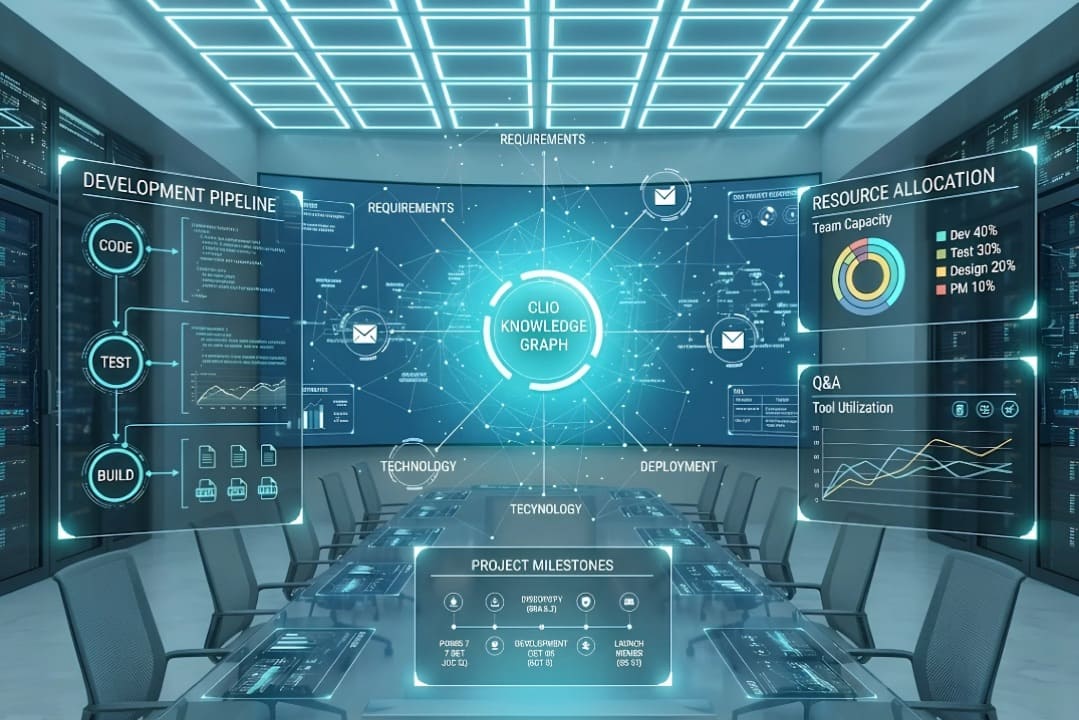
When an AI agent needs to know a feature’s specification, a screen’s interaction flow, or a prior architectural decision, it queries Clio and receives organized information — not raw, unstructured documents. Agents follow connections between entities rather than keyword-matching across isolated files.
The result: AI agents that are reasoning against your specific system — your domain, your decisions, your standards – not pattern-matching against general training data.
What changes for your projects
Decisions and estimates become faster and more accurate
Without structured knowledge infrastructure, every moment a team member needs context becomes a small research project. They query multiple sources, evaluate conflicting versions, and either make a judgment call on incomplete information or interrupt a colleague to get a definitive answer. This happens dozens of times per sprint, across every role on the team.
With Clio, accurate context is accessible in seconds, making it the bedrock of Sun* AI-Driven Development. The right spec version, the relevant architectural decision, the current test case status — all queryable from a single, organized source.
For estimation and proposals specifically, Clio enables AI-assisted retrieval from validated past project knowledge. Estimates built on structured prior context are more accurate than estimates built on memory. Proposals that reference comparable prior work reflect a deeper understanding of scope and risk — and that quality difference is visible from the first deliverable.
Proposals and Estimates Become More Accurate and Less Time-Consuming
Estimation and proposal quality have always been constrained by how much relevant prior knowledge a team can actually access. In most engagements, that means what the senior team members happen to remember from similar projects, a ceiling that is both low and inconsistent.
Clio removes that ceiling. Structured access to prior project knowledge means estimation and proposal creation in Sun* AI-Driven Development are accelerated by AI-assisted retrieval from validated past context—not from memory, not from manual searches through archived folders, but from a knowledge base that is organized and queryable by design.
For clients, more accurate estimates mean fewer mid-project surprises. Proposals built on structured knowledge reflect a deeper understanding of scope and risk — the kind of depth that comes from actually referencing comparable prior work rather than approximating it. The quality difference is visible from the first deliverable, and it carries through every scoping and planning conversation for the duration of the engagement.
AI agent output aligns with your system — not generic training data
This is where knowledge infrastructure has the most direct and measurable impact on delivery quality.
When agents are fed raw Figma exports, unstructured Confluence pages, or ad-hoc prompts, their output reflects that fragmentation. The code misaligns with existing architecture. Suggestions contradict established patterns. Rework follows.
When agents query Clio, they receive structured, validated context specific to your project. The output they produce aligns with the system they are building into — which means AI-assisted development that actually reduces rework instead of creating it.
For teams measuring ROI on AI tooling, this is the difference between AI that accelerates delivery and AI that creates a different kind of technical debt.
Team scaling and onboarding stop being knowledge transfer problems
On any engagement that runs longer than a few months, team composition changes. Engineers rotate in. New members join as scope expands. Key contributors move to other projects.
In a typical engagement, each of these transitions creates a knowledge transfer event — a period of reduced productivity while the new team member reconstructs context from scattered sources, and a period of senior engineer distraction while they field the questions that come with it.
With Clio, new team members can query project knowledge directly. They arrive at their first planning session with accurate context already available — not because someone walked them through it, but because the context lives in the system rather than in specific people.
In long-running projects, where team composition shifts are inevitable, this removes one of the most predictable delivery risks in Sun* AI-Driven Development.
How it fits into your delivery
Clio integrates into Sun* AI-Driven Development as the knowledge foundation that every other AI-assisted action depends on. It uses the same MCP architecture as Sun* MoMorph — Sun*’s design-to-code platform — forming a coherent context infrastructure across the full SDLC.
In practice, structured project knowledge makes the following reliable rather than manual: Q&A generation, function list generation, screen flow generation, estimation, and proposal creation.
These are the stages where accuracy and speed matter most — scoping, planning, and delivery initiation — and where fragmented knowledge typically creates the most friction.
Clio is not a standalone tool. It is the layer that makes every AI-assisted action on a Sun* project more reliable.
What this means in practice
When project knowledge is structured and accessible, everything that depends on it improves.
On Sun* engagements, Clio ensures that condition is met from day one. Decisions run on current information. Estimates reflect structured prior knowledge. AI agents produce output aligned with the actual system. And when teams change — which they always do — the knowledge stays accessible.
If your team is running AI-assisted development and the output quality is inconsistent, the question worth asking is not which model to switch to. It is what your agents are working from.
Interested in how Sun* Clio could apply to your next projects? Talk to our AI engineer team.