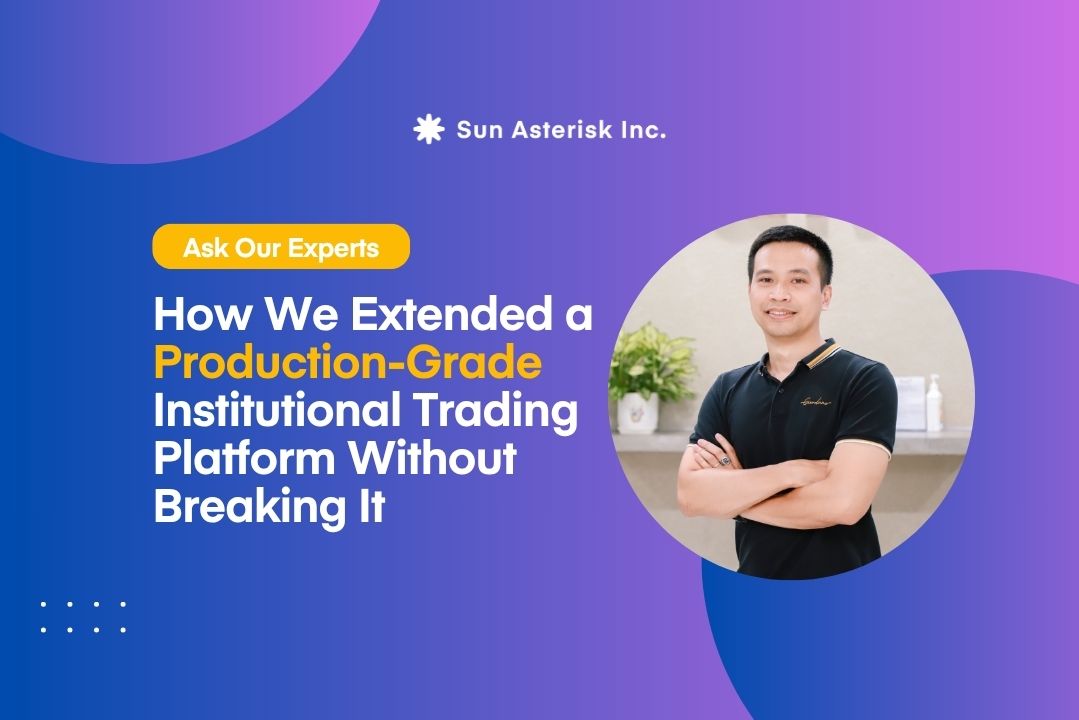
Institutional fintech platform development teaches a simple lesson: the most dangerous thing you can do in a regulated fintech system is assume you understand it before you actually do.
Our solutions architect reflects on what it really takes to extend a live institutional trading platform – one already operating under AFSL licensing, handling perpetuals, spot, options, and FX products – and why the discipline of understanding before building separates teams that earn long-term trust from those that create technical debt at the worst possible moment.
What We Were Actually Walking Into
The client was not a startup. They were not building from scratch. When Sun* joined the engagement, the platform was already running in production—a mature institutional digital asset trading system licensed under the Australian Financial Services Licence (AFSL), with a core built on C#/.NET and PostgreSQL and a separate compliance portal handling onboarding, KYC/AML processes, and document management.
Real users, trades and regulatory obligations.
What was missing wasn’t the platform. It was the capacity to scale it—safely, consistently, and without compromising the architecture that had been carefully built before we arrived.
This is a common challenge in institutional fintech platform development: the technology foundation exists, but growth demands new capabilities without introducing operational or compliance risk.
The client needed three things:
- A multi-channel notification system capable of handling email, SMS, and real-time messaging.
- Expanded user configuration capabilities within the existing API.
- An independent security assessment of the compliance portal before they further scaled their institutional customer base.
What they did not need—and what would have been the wrong instinct entirely—was for us to come in and rebuild or reimagine. The mandate was to extend, not replace.
Successful institutional fintech platform development is often less about introducing new architectures and more about preserving what already works while enabling the business to scale with confidence.
The Challenge Was Changing a Live System Without Breaking What Already Worked
Every new module had to be architecturally indistinguishable from what already existed. Not merely functional—indistinguishable. That meant matching naming conventions, following established design patterns, and operating within a strict propose → approve → implement workflow before writing a single line of production code.
100% unit test coverage. No regression. No downtime. Multiple technology stacks operating simultaneously, each with its own risk profile.
These aren’t unreasonable requirements for a regulated institutional platform. They are, in fact, exactly the right requirements. But they create a very specific kind of pressure: the pressure to understand deeply before acting at all.
The first thing the team did was not write code. It read the system.
We used AI tools, including Claude, to analyze the existing codebase at scale—mapping architectural patterns, identifying established conventions, and building a mental model of how the system was designed to evolve. Assumptions were documented, proposed approaches were validated with the client before implementation began, and pull requests included explicit design rationale—not just the change itself.
This approach reflects a broader shift in institutional fintech platform development, where success depends as much on architectural discipline and governance as it does on delivery speed.
In our ongoing effort to deliver better outcomes for clients, we have been building Sun* AI-Driven Development—an initiative to embed AI capabilities across the entire software development lifecycle, from specification through delivery.
On this engagement, that meant faster codebase comprehension, stronger test coverage, and sharper architectural consistency checks before anything reached production. For complex institutional fintech platform development projects, these capabilities help teams move faster while maintaining the reliability, compliance, and engineering rigor that regulated environments demand.
The initiative is built around 04 tools: Sun* Clio, which structures scattered project knowledge into reliable AI agent output; Sun* MoMorph, which closes the spec gaps that stall AI-assisted teams; Sun* Nereus, which turns project communication into structured delivery intelligence and Sun* Meet – AI-augmented meeting intelligence that extracts decisions, actions, and context from every project conversation
Together, they help clients move faster without sacrificing the consistency and quality that regulated environments demand.
This is not how most engineering teams operate under delivery pressure. It is, however, the only approach that works in a production-grade system you didn’t build yourself.
What Our Team Learned About Keeping a Live System Stable While Extending It
Test-first wasn’t optional – it was structural
Meeting 100% unit test coverage on an existing production system requires more than discipline. It requires a fundamentally different way of thinking about code design. We adopted a test-first mindset across the team, using AI tooling to generate test cases, identify execution paths that weren’t covered, and refactor code structures to be more testable without changing their behavior.
The result wasn’t just coverage for compliance reasons. It was a deeper understanding of the system’s edge cases – the kind of understanding that only surfaces when you’re forced to write a test for every possible execution path before you consider the feature done.
Documentation as a first-class deliverable
Every pull request shipped with documentation explaining not just what changed, but why – the design decision, the alternative approaches considered, the tradeoffs made. In an institutional fintech system where engineers rotate and teams grow, documentation isn’t a nice-to-have. It’s what prevents the next team from making the same wrong assumptions you corrected six months ago.
AI as a co-pilot for codebase comprehension
Modern enterprise codebases are too large for any individual to hold entirely in their head. We used AI tools deliberately – not to generate code we didn’t understand, but to accelerate comprehension of what already existed. Pattern recognition at scale. Consistency checking across modules. Identifying where a proposed change might interact with existing behavior in ways that weren’t immediately obvious.
The output was better architectural proposals, validated faster, with fewer surprises in code review.
The Security Assessment: Finding What Wasn’t Visible
The most consequential piece of work in the engagement had nothing to do with feature delivery. Our client needed an independent security assessment of their compliance portal – the system handling KYC/AML processes, onboarding, and document management for an AFSL-licensed institutional platform.
The portal was operational. It was not the problem. But the client understood, correctly, that scaling an institutional business on a compliance infrastructure that had never been independently assessed was a strategic risk they couldn’t afford to carry forward.
We conducted a structured assessment covering 04 domains:
- Architecture review – evaluating whether the portal’s design introduced systemic risks, including how components were separated, how dependencies were managed, and whether the overall structure could support the security controls required at institutional scale.
- Access control analysis – examining how user roles, permissions, and authentication were implemented across the portal, and identifying where privilege boundaries were insufficiently enforced or where access paths created exposure.
- Personal data protection – assessing how sensitive customer data – identity documents, financial records, KYC submissions – was stored, transmitted, and protected, against the obligations of a regulated financial services environment.
- Financial data handling – reviewing how the portal managed data integrity and auditability in processes directly connected to onboarding decisions and compliance outcomes.
The assessment identified 31 findings across multiple severity levels. Several were critical. Not critical in the sense of theoretical risk—critical in the sense that a failure in these areas would not generate a support ticket. It would generate a regulatory event.
As part of a broader institutional fintech platform development initiative, what we delivered was not a vulnerability list. It was a structured remediation roadmap: findings prioritized by severity and business impact, with clear guidance on what needed to be addressed before the client expanded their institutional customer base further.
Conducting a security evaluation of an operational financial architecture is not an exercise in assigning blame. It is about providing technical leadership with a transparent and objective view of the platform’s current posture—ensuring that expansion strategies are driven by empirical data rather than hopeful projections.
The assessment was one part of a broader engagement that also delivered a fully decoupled multi-channel notification service and extended User Management API capabilities, both with zero regression impact and complete test coverage. But of the three deliverables, the security assessment carried the most immediate business weight. It gave the client a clear, prioritized view of where their compliance infrastructure stood before they scaled further, reinforcing the importance of security and governance in institutional fintech platform development. That transparency, more than any single feature shipped, was what shifted the relationship from vendor to trusted technology partner.
03 Things That Actually Matter in Regulated Fintech Delivery
Looking back at the engagement, three principles account for most of what went right.
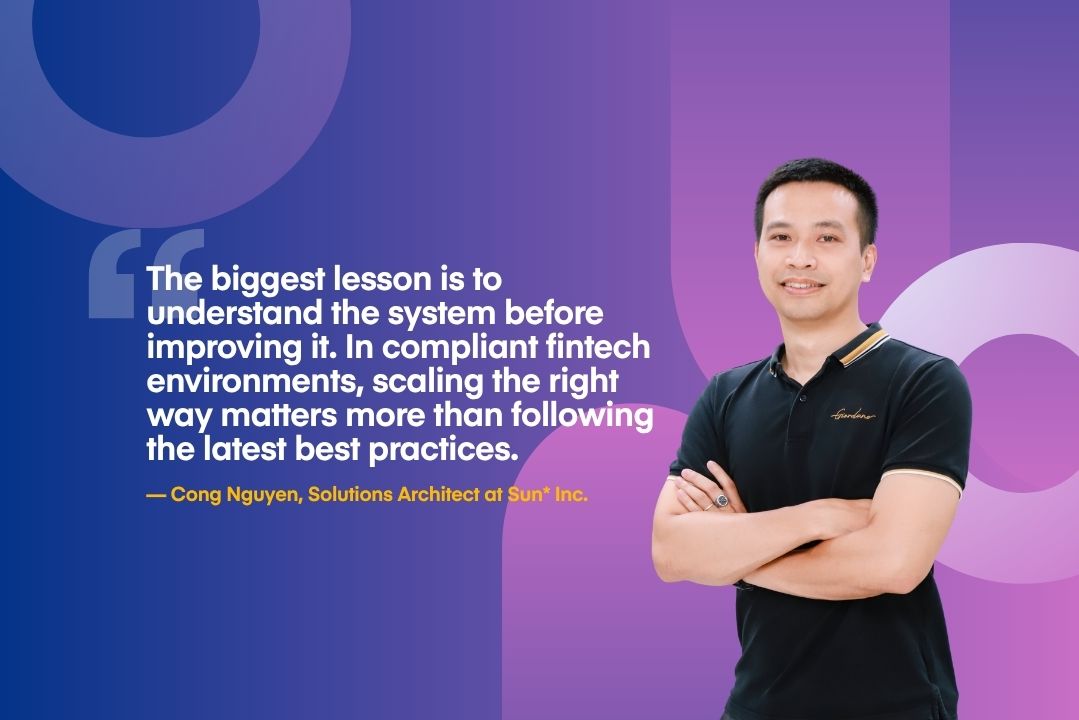
Understand the system before you try to improve it. This sounds obvious. Most teams skip it under delivery pressure. In a mature production system, the hours spent building a reliable mental model of how the system actually works – not how the documentation says it works, not how you’d design it today – are the hours that prevent expensive mistakes later. One of a lead’s responsibilities is protecting that learning phase, even when timelines are tight.
Different stacks carry different risk profiles. A core trading platform and a compliance portal are not the same kind of system. They have different failure modes, different regulatory exposures, and different tolerances for ambiguity. A security finding that’s a medium severity in one context may be critical in another, depending on what data it touches and what regulatory framework governs it. Effective technical leadership means evaluating each system within its own context, not applying a single risk standard universally.
Critical feedback is information, not opposition. Fintech technical reviews are demanding by design. The objective isn’t to avoid criticism – it’s to earn trust by responding to criticism with evidence, transparency, and consistent judgment over time. The teams that do this well don’t just survive rigorous review cycles. They become the partners that institutional clients trust with their most sensitive systems.
In institutional fintech, trust is the product. Everything else is how you build it.
Working with a regulated institutional fintech platform that needs to scale without compromising architectural integrity or compliance posture? Sun* engineers work inside your system – not beside it.