Selecting the ideal partner for custom fintech software development services is more than a simple purchasing choice, it is a major, high-stakes commitment for your organization.
In most industries, a software vendor builds features. In fintech, a partner shapes how money moves, how risk is controlled and how regulators perceive your business.
At Sun*, we’ve worked alongside fintech teams at different stages, from early product builds to complex system modernization. The pattern is consistent: success rarely depends on a single breakthrough decision. It’s the result of getting foundational choices right early, especially when selecting a development partner.
This guide distills those lessons into a practical framework you can use to evaluate vendors with clarity and confidence.
- Fintech vendor selection is fundamentally different from general software outsourcing
- Strong partners demonstrate depth across compliance, security, architecture, and the delivery process
Why choosing the right custom fintech software development partner is critical?
The global fintech software market was valued at $305 billion in 2024 and is projected to reach $1.5 trillion by 2033. The opportunity is enormous, but so is the complexity.
Financial platforms sit at the intersection of security requirements, shifting regulatory frameworks, high-concurrency transaction systems, and user trust. One wrong decision at the vendor selection stage and you’re rebuilding in six months.
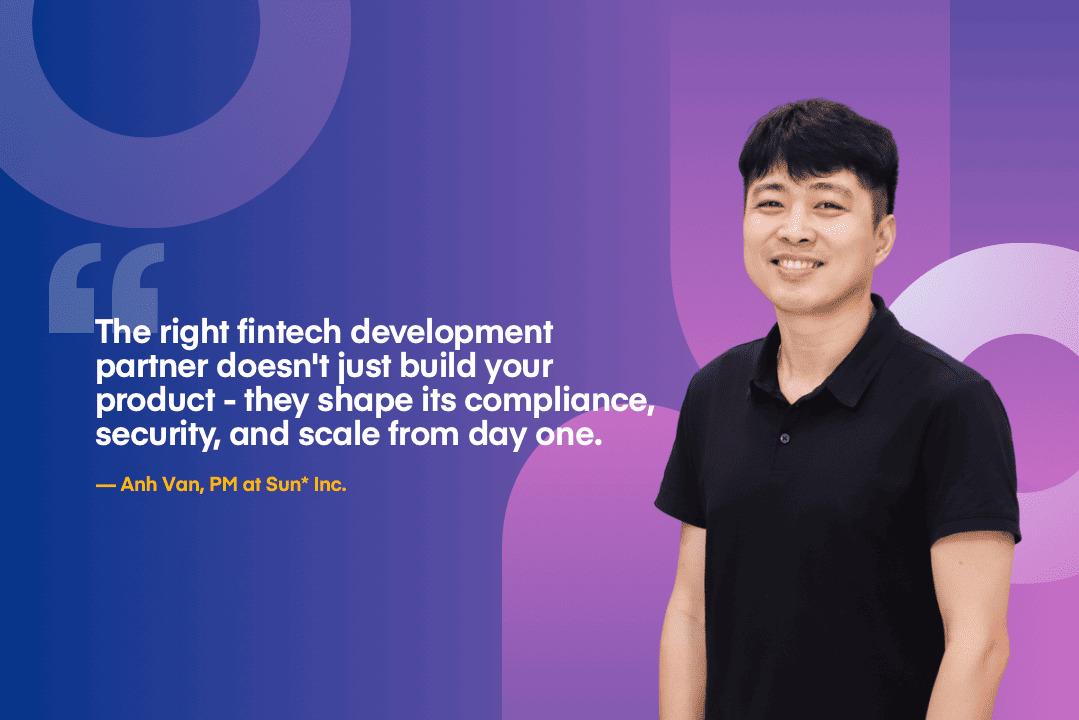
The right partner for custom fintech software development services shapes how your product handles compliance, security, and scale from day one.
In fintech, gaps don’t stay isolated; they compound.
A weak approach to regulatory requirements can delay launches or trigger audits, poor security practices can expose sensitive financial data, and fragile architecture can break under growth.
The right partner reduces these risks by thinking beyond features – designing systems that are auditable, resilient, and ready for real-world complexity.
A Practical Guide to Custom Fintech Software Development Services
Agentic AI is actively reshaping how fintech products are built and evaluated.
Unlike conventional AI that suggests actions, agentic systems autonomously execute multi-step financial workflows: processing loan applications, flagging suspicious transactions, routing payments, and onboarding customers without human approval at every step.
Global spend on agentic AI hit an estimated $50 billion in 2025, with 44% of finance teams expected to be using it by 2026 – a jump of over 600% year-over-year. But the infrastructure hasn’t caught up with the ambition: only 2% of companies had adequate AI guardrails in place in 2025, and 95% had experienced at least one AI incident.
Regulatory frameworks have yet to explicitly address agentic systems, leaving accountability for autonomous financial decisions largely unsettled. When evaluating a development partner, ask directly:
- Can they build agentic systems where every autonomous action is auditable?
- Do they have a governance framework for AI decisions that touch real money and real user data?
- A partner who hasn’t worked through these questions will be working through them at your expense.
1. Compliance and Regulatory Readiness
Fintech compliance is an architectural imperative. A prospective partner must demonstrate profound, applied experience with relevant regulations (e.g., KYC, AML, PSD2, GDPR), specifying the implemented frameworks and markets, and detailing their integration at the code and workflow level.
Continuous compliance is paramount; regulations evolve (e.g., DORA, global privacy frameworks). A strong partner maintains proactive monitoring, leverages legal counsel, and possesses a defined process for integrating regulatory updates mid-project.
Furthermore, their responsibility extends post-launch to provide comprehensive audit trails and documentation for regulatory inquiries.
The decision to embed compliance systems reduces data breaches by 58% compared to reliance on post-development audits. Vague assertions like “we follow best practices” are insufficient; compliance must be architecturally designed to scale. The absence of scalable compliance leads to backlogs, delays, and costly remediation, irrespective of technical product performance.
2. Security & Data Protection Standards
Security in fintech is the foundation everything else is built on. Users trust your platform with their money, their identity, and their financial history. A partner who treats security as a scoped deliverable – something to estimate and include as a line item – isn’t approaching this the right way.
The basics to establish upfront: does the vendor hold verifiable certifications like ISO 27001, PCI DSS, or SOC 2 Type II?
Ask to see the actual documents, not a reference to them on a sales deck. Ask when they were last audited. Certifications are table stakes; what the vendor says after you ask is where you learn whether security is genuinely embedded in how they work.
From there, go into specifics.
- How do they handle encryption, role-based access control, and data isolation between tenants?
- Who within their organization can access your client data, and under what conditions?
These aren’t difficult questions for a team that has actually done this in financial systems – they answer them fluently because they’ve had to think them through before.
Incident response matters just as much as prevention. A reliable partner can walk you through exactly what happens when something goes wrong: how anomalies are detected, how incidents are contained, and how clients are kept informed. In fintech, that clarity under pressure is part of what you’re hiring for.
Data breaches in fintech cost over $5 million on average. Building security in during the design phase is dramatically cheaper than responding to a breach after launch – financially and reputationally.
When vendors claim that hosting on AWS or another major cloud provider makes them compliant, that’s a conflation worth pushing back on. The cloud infrastructure may be certified, but the vendor’s own code and processes are evaluated separately.
Ask for a real SOC 2 Type II report, not a hosting provider’s compliance page.
3. Technical Expertise and Scalability
Technical depth in fintech is not the same as general software development experience. Fintech systems operate under constraints that most development teams have simply never had to navigate. The gap between a team that understands these constraints and one that doesn’t show up early and gets expensive fast.
Domain expertise is the first thing to assess. A vendor who has shipped payment platforms, lending systems, or digital banking products in your segment will speak differently about your project than one who hasn’t.
One practical signal: do they bring up idempotency when discussing API-first financial transaction design? It’s a specific, non-obvious concept and in fintech, getting it wrong means duplicate payments from retry logic errors.
Teams that have operated in real financial systems know to design against this from day one.
Architectural thinking is the second dimension.
Strong fintech teams design for the messy realities of financial systems. They build proper ledger structures and audit trails not because they were asked to, but because they understand why those things matter in production.
Ask a prospective vendor to describe a project where they had to scale under pressure. What did the original architecture allow for? What had to be rebuilt?
Integration experience completes the picture. Connections to payment gateways, open banking APIs, and KYC/AML providers each carry their own complexity and failure modes.
A vendor with real experience in this area will talk about it with specificity. One without it will give you generalities.
Partnering with a team that has proven fintech domain expertise can cut project delivery time by nearly 20% while meaningfully improving product reliability from launch.
Any vendor who frames scalability as something to “address in a future phase” is describing a future re-engineering project. Scalability is an architectural decision, not a feature, and retrofitting it after launch is far more expensive and disruptive than designing for it up front.
4. Development Process and Quality Assurance
How a team works tells you as much about their reliability as what they’ve shipped. A process without visibility, without structured testing, or without clear accountability is a process that will eventually cost you.
The first thing to establish is delivery rhythm. Do they work in sprints and ship working software incrementally? What does a sprint review involve, and how are clients kept informed between milestones? A team with a real process answers this specifically. A team without one tends to describe their methodology in broad strokes while staying vague about the details.
Quality assurance deserves equal attention. Ask about their testing approach — unit tests, integration tests, end-to-end tests and how automated testing fits into their deployment pipeline. Ask how code review works and how technical debt is managed over the course of a project.
In custom fintech software development services, these aren’t optional practices, they’re the difference between a system you can maintain and extend, and one that accumulates fragility with every sprint.
A strong fintech development partner also brings a product mindset, not just an engineering one.
They flag risks before they become problems, ask questions about your business goals rather than just your feature list, and treat the engagement as a collaboration rather than a spec execution exercise.
One question worth asking directly: how do they govern AI-assisted development?
Many vendors now use AI tooling to accelerate output – which can be valuable but without proper review processes, AI-generated code can introduce security and compliance vulnerabilities that are particularly difficult to detect in financial systems.
A vendor who issues a fixed-price quote without a discovery phase first — before reviewing your data schema, integration landscape, and compliance requirements — is skipping the step where they would learn what the project actually involves.
In fintech, the real complexity lives in the integrations and compliance logic, not the visible screens. A discovery phase isn’t overhead; it’s due diligence.
5. Experience, Transparency, and Long-term Support
Launch day is the beginning, not the end. Regulations evolve, user bases grow, and security threats don’t pause after go-live. The partner you choose needs to be someone you can genuinely work with over the long arc of your product.
Start with their track record. Ask for reference clients you can actually speak to – not case study PDFs, but people who will tell you what the engagement was really like. Focus on projects with similar compliance complexity and integration scope to yours. Ask what went wrong as much as what went right. A team’s ability to handle problems honestly says more about them than their ability to present polished successes.
Pricing and support transparency matters just as much.
A vendor who is vague during the sales process about cost and scope will often be equally vague when a production incident hits at 2am.
Get the post-launch terms in writing: what SLAs apply to incident response? What does ongoing maintenance include? What happens when a regulatory change requires a system update?
Pricing and support must be transparent. Vague vendors during sales are often vague during production incidents. Get post-launch terms in writing: incident response SLAs, maintenance scope, and handling of regulatory updates.
Some of the most important signals come before the contract is signed – how the vendor listens, what questions they ask, whether they challenge your assumptions or just validate them.
A team that asks about your business goals alongside your feature requirements is a team that understands they’re building something that has to perform in the real world, not just pass a demo.
Nearly 75% of successful fintech applications receive significant updates within the first year of launch. The post-launch relationship isn’t a formality – it’s a meaningful part of the total engagement.
A vendor without a verifiable fintech delivery history is a real risk, regardless of how well they present.
Without case studies that show how they handled transaction integrity, regulatory constraints, or production incidents in actual financial systems, there’s no evidence they’ve operated under these conditions before.
Best Practices for Custom Fintech Software Development
If there’s one pattern we’ve seen repeatedly, it’s this: most teams don’t fail because of a single bad decision; they fail because they evaluate the wrong things too late.
What separates the builds that ship from those that stall comes down to real domain experience, architecture thinking, a security-first mindset, process maturity, and communication clarity.
One tip that saves founders a lot of pain: start with a paid discovery phase before committing long-term. You’ll spot red flags faster in two weeks of real work than in ten hours of sales calls.
These best practices are based on our extensive experience with numerous fintech projects, highlighting lessons learned from those that successfully launched and those that encountered difficulties.
1. Start With Compliance Architecture, Not Compliance Retrofitting
Regulatory requirements shouldn’t be something you “add” before launch. They need to be part of the system design from the very beginning – how data flows, how actions are logged, how decisions are traceable.
Teams that treat compliance as architecture consistently outperform those trying to retrofit it later.
2. The First 30 Days Will Tell You Everything About the Partnership
Assessing the viability of a fintech partnership does not require an extended period. The initial 30 days typically provide a clear indication of success.
This critical phase establishes communication protocols, solidifies the technical trajectory, and determines whether expectations converge or diverge.
Should ambiguity or sluggishness arise early on, it is seldom rectified in subsequent stages.
3. Demand Internal DevOps
Adding more engineers won’t solve infrastructure problems. Fintech systems rely heavily on secure environments like VPC configurations, IAM policies, and deployment pipelines, and these require dedicated DevOps expertise.
Without it, teams end up shipping slower, with more risk and less control.
4. Verify Depth Of Experience
The fintech industry necessitates specialized expertise, precluding on-the-job learning.
Should a development team lack demonstrable experience collaborating with regulated entities, it is advisable to seek alternative partners.
A generic, standardized methodology applied indiscriminately across various industries serves as a significant caveat.
5. Insist on a Unified Codebase
Some platforms look polished on the surface but are held together by multiple stitched systems underneath, often the result of acquisitions or rushed integrations.
The problems only show up later: inconsistent data, disconnected tools, and difficult updates. A unified architecture may take more effort upfront, but it pays off in stability and scalability.
Simple Checklist: Choosing a Fintech Software Development Partner
| Compliance |
|
| Security |
|
| Technical |
|
| Process |
|
| Partnership |
|
Choosing a partner for custom fintech software development services is not about ticking technical boxes.
It’s about finding a team that:
- Understands regulatory complexity
- Designs for security from day one
- Builds systems that scale under real-world pressure
- Operates as an extension of your product team