Fintech investment hit nearly $116 billion in 2025, driving demand for fast, secure, and scalable solutions in digital payments, blockchain, mobile banking, and AI tools.
Traditional outsourcing hubs face rising costs and geopolitical risk, pushing businesses to seek the next great fintech engineering hub and fintech development outsourcing in Vietnam is quickly becoming the answer. The country offers a dynamic pool of over 560,000 developers, 30–50% lower costs than Western markets, and strong government backing, including over $5 billion in digital infrastructure investment.
With a domestic fintech market valued at USD 16.9 billion in 2024 (projected to reach USD 62.7 billion by 2033), Vietnamese engineers gain practical, at-scale experience daily.
Vietnam’s appeal is examined for fintech outsourcing: its talent, cost advantages, engagement models, best-suited domains, and leading partners.
Key takeaway
- Vietnam offers a rare combination of cost efficiency and engineering depth — with 560,000+ developers, rates 30–50% lower than Western markets, and a fast-growing domestic fintech ecosystem that keeps teams sharp.
- Fintech Development Outsourcing in Vietnam works best for engineering-intensive, scalable systems — from core banking modernization and payment infrastructure to KYC/AML tooling and trading platforms.
- Success depends on the right model and partner — whether dedicated team, managed, or BOT, the strongest outcomes come when offshore teams own execution and internal teams retain control over strategy, compliance, and risk.
Why outsource fintech development?
Fintech development outsourcing has evolved from a cost-arbitrage tactic into a strategic imperative for capability scaling. Global financial institutions and high-growth fintechs are increasingly facing a “triple constraint”: aggressive go-to-market timelines, stringent regulatory evolution, and a chronic shortage of specialized engineering talent.
By decentralizing development to elite offshore hubs, organizations can bypass local hiring bottlenecks and tap into specialized expertise, such as blockchain architecture and AI-driven compliance without diverting internal focus from their core product vision.
Ultimately, outsourcing provides a practical way to extend engineering capacity while maintaining focus on core business priorities.
Cost Efficiency – Strategically: Companies typically reduce development costs by 30–70% by eliminating the hidden overhead of recruiting, onboarding, and retention. In fintech, those savings can be redirected toward compliance, security architecture, and product differentiation.
Speed to Market: Fintech operates in fast-moving environments where launching months earlier drives real adoption and revenue. Outsourcing partners bring ready-to-deploy teams, established workflows, and reusable components that can accelerate delivery by up to 25%, from idea to MVP, and from MVP to scale.
Access to Specialist Expertise: AI-driven fraud detection, blockchain integration, cloud-native banking, and RegTech tooling require niche experience that is increasingly difficult to build internally. Outsourcing gives immediate access to teams that have already delivered these systems, reducing ramp-up time and execution risk.
Scalability Without Friction: Fintech development is rarely linear. Teams need to expand for product launches, adapt to regulatory updates, and contract during stabilization. Outsourcing enables this flexibility without the long-term commitments of traditional hiring, keeping cost structures aligned with actual growth stages.
Internal Focus on What Matters Regulatory ownership, risk management, and customer experience cannot be delegated. By externalizing execution while retaining strategic control, organizations can balance innovation with compliance and speed with stability.
Why Vietnam for fintech outsourcing?
Fintech organizations now evaluate outsourcing destinations based on engineering capability, ecosystem maturity, regulatory awareness, and scalability, not just cost.
When it comes to Fintech Development Outsourcing in Vietnam, the case is compelling on all fronts: a technically capable, rapidly growing workforce, competitive costs, and a stable economy, all backed by a fast-evolving digital and financial ecosystem.
Crucially, Vietnam’s increasing exposure to real-world financial systems means Vietnamese teams offer a deeper understanding of industry-specific challenges, contributing significantly to product development beyond mere execution.
A talent pipeline that does not slow down
Vietnam has built one of the largest and fastest-growing developer bases in Southeast Asia, with over 500,000 IT professionals and approximately 50,000 new graduates entering the workforce each year. This steady pipeline is driven by a national emphasis on technical education and digital skills development.
Unlike some outsourcing markets that focus heavily on general IT services, Vietnam’s workforce shows a strong orientation toward engineering disciplines and applied technologies, including backend systems, cloud infrastructure, and increasingly AI/ML. This makes it particularly suitable for fintech, where system reliability and scalability are critical.

Competitive Cost Structure
Vietnam offers a highly competitive pricing model, with average developer rates ranging from $20 to $45 per hour, compared to $80–$150+ in the US and $60–$120 in Western Europe.
However, the key advantage is not just lower cost, it is the value-to-cost ratio. Companies are able to access mid-to-senior level engineers at significantly lower rates while maintaining solid delivery quality. Compared to other outsourcing destinations like India or Eastern Europe, Vietnam is often seen as a balance between affordability and engineering rigor.
For fintech firms, this allows budget reallocation toward security, compliance, and product innovation, rather than pure development spend.
Stable Economic Growth
Vietnam’s macroeconomic stability plays a significant role in its attractiveness as an outsourcing destination. The country has maintained GDP growth of approximately 5–7% annually over the past decade, even amid global economic fluctuations.
This stability is reinforced by government initiatives that actively promote digital transformation, fintech innovation, and foreign investment in technology sectors. Policies supporting IT outsourcing, startup ecosystems, and digital infrastructure have created a favorable environment for long-term partnerships.
For fintech companies, this reduces geopolitical and operational risk when establishing offshore development capabilities.
Expanding Fintech Ecosystem
Vietnam’s domestic fintech ecosystem has grown rapidly, with 200+ fintech startups operating across payments, digital lending, blockchain, and wealth management. This growth is supported by increasing smartphone penetration, a young digital-native population, and strong demand for financial inclusion.
Importantly, there is growing collaboration between fintech startups, traditional banks, and international investors. This ecosystem exposure gives Vietnamese engineers real-world experience in financial systems, rather than purely theoretical or outsourced work.
As a result, outsourcing partners in Vietnam are increasingly familiar with fintech-specific challenges such as KYC/AML, payment integrations, and regulatory constraints.
Strategic Location in Asia Pacific
Vietnam’s time zone facilitates practical collaboration, aligning well with major APAC markets and allowing overlapping working hours with Europe. This proximity supports hybrid delivery models and near real-time collaboration, significantly improving efficiency for fintech projects requiring frequent communication.
Furthermore, its location near financial hubs strengthens its role as a regional delivery center, especially for companies expanding into Asia-Pacific.
What to expect when working with Vietnamese Teams?
1. Development quality and standards
Vietnamese engineers are well-versed in modern software practices and increasingly experienced in fintech-related systems, making Fintech Development Outsourcing in Vietnam a technically sound choice for global organizations. Most teams work within Agile or Scrum frameworks, with structured sprint planning, regular reviews, and continuous improvement cycles.
There is strong adoption of cloud-native architectures, microservices, and API-driven development, particularly important for fintech platforms that require scalability and integration.
While quality levels can vary by vendor, established firms typically align with international standards such as secure coding practices and where required, compliance frameworks like PCI-DSS.
2. Communication and collaboration
Vietnamese teams are generally comfortable working in distributed, global environments. English proficiency in tech teams is solid, especially in written communication, and most teams are familiar with tools such as Jira, Slack, and Confluence.
Day-to-day collaboration often includes daily stand-ups, sprint demos, and asynchronous updates. That said, clarity is key – teams tend to perform best when requirements, priorities, and acceptance criteria are well-defined. Over time, many teams become more proactive, contributing not just to execution but also to solution design.

3. Security and compliance awareness
Growing involvement in global and fintech projects has significantly increased the capability of many Vietnamese development teams. These teams are often knowledgeable about concepts like secure system design, data privacy, and KYC/AML. Vendors typically maintain internal security practices, such as data protection measures, access controls, and code reviews.
However, a crucial point is that regulatory ownership must remain with the client, especially in highly regulated markets. The strongest partnerships clearly delineate this responsibility: offshore teams handle execution, while the client retains strategic control over risk management and compliance.
Fintech projects well-suited for Vietnam outsourcing
Core banking modernization is a key use case. Financial institutions are moving from legacy systems to flexible, cloud-native architectures. Vietnamese engineering teams excel in supporting this shift through microservices, API enablement, and system integration. They can incrementally modernize components, reducing risk while boosting bank performance and scalability.
Payment infrastructure (gateways, digital wallets, real-time transaction systems). These projects demand high reliability, scalability, and complex third-party integration. Their expertise with API-driven architectures makes them ideal for handling integrations across various payment networks and financial platforms, especially in fast-growing digital payment sectors.
For Lending and credit platforms, outsourcing to Vietnam is effective for developing full digital experiences, from user interfaces to backend processing. They can build automated workflows, customer onboarding, and AI-driven credit scoring. These projects thrive with iterative development and optimization, fitting the offshore model well.
Outsourcing KYC/AML and RegTech tooling offers significant value. Though regulatory ownership must stay internal, Vietnamese engineering can build and maintain systems like identity verification, document processing, and fraud detection engines. Their growing compliance project experience means they understand the technical requirements of regulatory frameworks, even if final accountability remains onshore.
Vietnamese developers can deliver user-facing wealth management and trading platforms like portfolio dashboards, mobile trading apps, and analytics tools. This requires strong UI/UX and real-time data processing. Fintech Development Outsourcing in Vietnam is ideal for the product development layer, where quick iteration and UX improvements are key to competitiveness.
At the same time, it is important to recognize what should typically remain onshore or nearshore. Strategic functions such as regulatory decision-making, sensitive data governance, and core risk models are usually better retained internally or within closer jurisdictions. These areas require deep alignment with local regulations and business strategy, and often involve higher levels of accountability.
Fintech outsourcing to Vietnam is most effective when applied to engineering-intensive, scalable, and modular systems where offshore teams can deliver high-quality execution, while internal teams maintain control over strategy, compliance, and risk.
Fintech Outsourcing Engagement Models: Selecting the Right Approach
Choosing the right engagement model is a critical decision in fintech outsourcing, as it directly impacts delivery speed, cost control, and risk management. Unlike other industries, fintech projects often involve evolving requirements, regulatory constraints, and long-term product roadmaps, making Fintech Development Outsourcing in Vietnam a particularly well-suited choice, given its mature engagement options and adaptable talent pool.
Many fintech organizations start with a dedicated team or managed model, then evolve into hybrid or BOT structures as their products and offshore capabilities mature.
| Engagement Model | Key Characteristics | Best For | Considerations |
| Dedicated Team (Staff Augmentation) | External engineers work as an extension of your in-house team; full control over tasks and priorities | Long-term product development, continuous iteration | Requires strong internal management and clear product ownership |
| Managed / Outsourced Team | Vendor manages delivery, timeline, and team operations; client focuses on requirements and acceptance | Defined modules or features with limited internal bandwidth | Less direct control; requires clear scope and communication |
| Project-Based (Fixed Scope) | Predefined scope, timeline, and budget; vendor delivers end-to-end | Small, well-defined projects or MVPs | Less flexibility; higher risk in fintech due to changing requirements |
| Hybrid Model | Combination of dedicated team and managed services; shared responsibility | Scaling products with both flexibility and structure | Requires alignment on roles and governance |
| Build–Operate–Transfer (BOT) | Vendor builds and operates a team, then transfers ownership to the client | Long-term presence in Vietnam, building offshore capability | Higher initial investment; requires long-term commitment |
Leading fintech software development companies in Vietnam
The Fintech Development Outsourcing in Vietnam landscape is supported by a growing number of established software development firms with proven experience in financial services. These companies vary in scale and specialization, but many share strong engineering capabilities, exposure to global markets, and increasing expertise in domains such as digital banking, payments, and RegTech.
| Company | Team Size | Years of Experience | Core Fintech Services |
| Sun Asterisk | 4,000+ | 13+ years | AI/ML-powered fintech solutions, blockchain for financial services, digital banking & payments, Big Data for risk & compliance, cybersecurity, cloud-native financial platforms |
| FPT Software | 30,000+ | 30+ years (est. 1988) | Digital banking platforms, core banking modernisation, RPA for financial ops, cloud migration for BFSI, AI/data analytics |
| TMA Solutions | 4,000+ | 28 years (est. 1997) | Digital payment solutions, e-wallet development, wealth management platforms, fraud detection & compliance systems |
| NashTech | 2,500+ | 25+ years (est. 1999) | Core banking transformation, data & AI for financial services, process automation for insurers and banks, open banking APIs |
| Savvycom | 300+ | 15+ years (est. 2009) | Mobile & web banking applications, digital wallet development, payment gateway integration, KYC/AML systems, fintech consulting & MVP development |
Sun Asterisk: Your Fintech Engineering Partner in Vietnam
Sun* Inc. is a trusted global digital transformation partner with over 13 years of experience delivering ROI-driven IT outsourcing services – spanning AI/ML, custom software engineering, and IT consulting. Whether you’re looking to streamline operations, enhance customer experiences, or adopt emerging technologies, Sun* is committed to delivering results that matter.
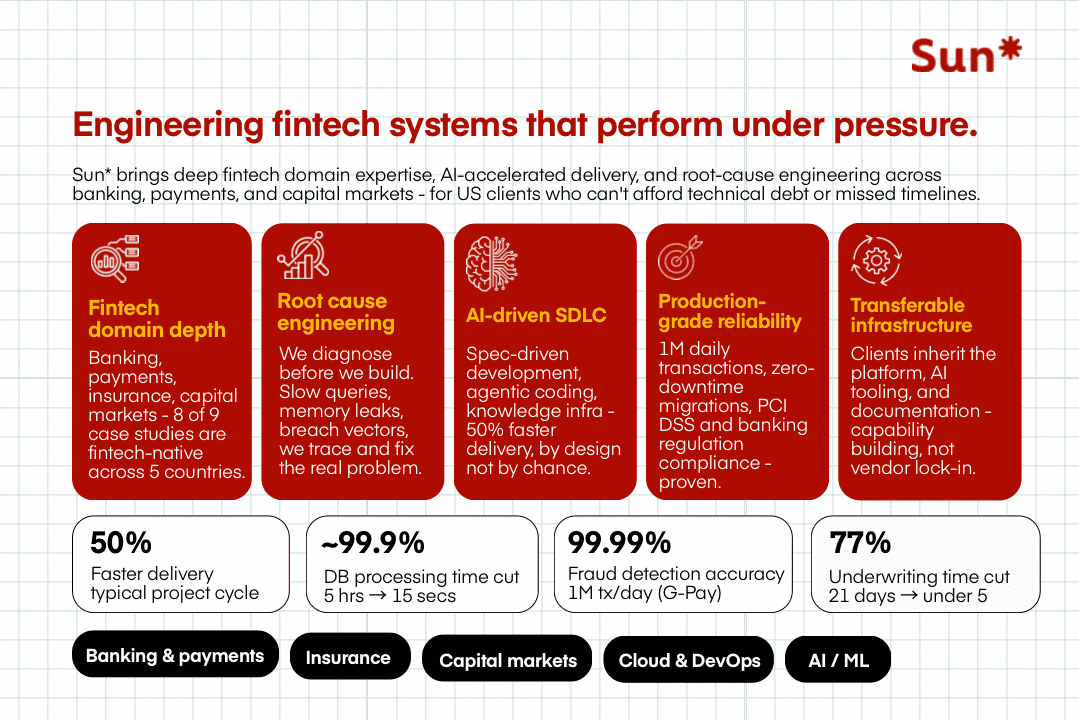
Our team works across the key technologies shaping fintech today: AI/ML for fraud detection and credit scoring, Big Data for transaction processing, and Blockchain for secure systems. These capabilities are further strengthened by deep expertise in cybersecurity, cloud, DevOps, and end-to-end product development — covering web and mobile apps, UI/UX design, and quality assurance — ensuring scalable and reliable platforms.
Sun* operates to global delivery standards, following best practices aligned with ISO and CMMI certifications, and applies Agile methodologies to enable fast, iterative development.
Headquartered in Vietnam, we offer the ideal balance of cost efficiency and high-quality execution, supported by multicultural teams that ensure clear, effective communication across international projects.
Ready to build your fintech product in Vietnam? Talk to our team.