Every financial services and insurance organisation is carrying some version of the same burden. Systems that were built to serve a different era of the business now sit at the centre of operations, quietly absorbing engineering capacity, slowing delivery cycles, and complicating every compliance obligation that lands on the desk.
The infrastructure works – just about, but the cost of keeping it working has become one of the most significant and least visible drains on the organisation’s operating budget.
What has changed in recent years is not the existence of this problem. It is the urgency of resolving it. As AI-driven capabilities move from experimental to operationally viable, the organisations best positioned to benefit are those whose data infrastructure was already in order. For everyone else, legacy architecture is no longer just an operational inconvenience; it is a strategic constraint.
In this article, we will examine where legacy infrastructure is consuming the budget, why it blocks the AI initiatives most insurers and fintechs are now prioritising and how to build a business case for modernisation that finance and risk stakeholders will find credible.
- Legacy infrastructure silently absorbs budget that should be driving growth
- Delivery speed is a revenue variable – modern stacks compress cycles from months to weeks
- Compliance debt compounds every year that modernization is deferred
- AI underwriting tools only perform when the data foundation beneath them is ready
Where Legacy Infrastructure Consumes Budget
Legacy infrastructure rarely appears as a single budget line item. Instead, its costs are spread across engineering teams, product delivery, operations and compliance functions, making them easy to overlook but increasingly difficult to absorb over time.
These inefficiencies can also limit the impact of insurance underwriting cost reduction AI initiatives, as outdated systems often create data silos, integration challenges and workflow bottlenecks. Understanding where these hidden expenses accumulate is often the first step toward building a compelling modernization business case.
Engineer Time Consumed By Maintenance
Among the more consistently underestimated costs is the proportion of engineering capacity directed at maintaining legacy integrations rather than delivering new capabilities.
In mature fintech organisations carrying five or more years of accumulated technical debt, industry benchmarks indicate that 20-35% of sprint capacity is routinely absorbed by workarounds, compatibility patches, and system babysitting.
Legacy core systems typically require custom coding for even minor updates, high consulting costs for specialized knowledge, dedicated infrastructure with excess capacity, and lengthy QA and testing cycles – costs that compound with each passing year.
The Feature Release Gap
The time-to-market differential between legacy and modern architectural approaches is one of the most compelling arguments for modernisation and one of the most concrete to quantify.
Neobanks and fintech companies built on modern technology stacks can deploy new features in days or weeks, while traditional institutions with legacy cores often require months or years for comparable capabilities, according to EY’s Global Banking Innovation Index (2025).
To translate that into operational terms: a new product line that requires six to nine months to reach production in a monolithic architecture could reach market in six to eight weeks on an API-first, modular stack. In categories where market timing is a primary competitive variable – embedded insurance, real-time payments, parametric products – that differential is often the difference between leading a segment and following it.
Outage Risk And Incident Cost
Infrastructure reliability is the dimension where legacy costs become most visible, and most costly to an organisation’s reputation. EMA Research’s 2024 analysis places the average cost of unplanned IT downtime at $14,056 per minute across all organisation sizes, rising to $23,750 per minute for large enterprises – representing a 60% increase from figures cited just two years prior.
For financial services organisations specifically, average annual downtime-related losses reach $152 million, with per-minute costs ranging from $12,000 upward.
Legacy systems are disproportionately represented in outage root cause analyses, owing to their brittleness under load, limited observability, and the reduced pool of engineers with the specialised knowledge required to diagnose and resolve incidents promptly.
Compliance Debt
Perhaps the most insidiously compounding cost category is compliance exposure. Regulations such as GDPR, the FCA’s operational resilience framework, and IFRS 17 do not pause to accommodate technology modernisation programmes.
Legacy systems frequently lack the audit trail infrastructure, data lineage capabilities, and structured access controls that contemporary compliance requirements demand – meaning organisations must layer manual processes on top, increasing both operational cost and residual risk.
The Bank for International Settlements estimates that banks spend $270 billion annually on compliance, a significant proportion of which is directed toward manual review of alerts generated by legacy systems.
When data is unstructured and distributed across disconnected platforms, retroactive compliance remediation becomes not merely expensive, but genuinely difficult to execute without introducing additional exposure in the process.
Why Legacy Infrastructure Blocks AI-Driven Insurance Underwriting Cost Reduction
The hidden costs of legacy infrastructure extend beyond engineering inefficiencies and operational overhead. They also create barriers to strategic initiatives that many insurers see as critical for future growth, particularly insurance underwriting cost reduction AI initiatives.
As organizations pursue greater automation and efficiency, legacy systems often become the primary obstacle standing between AI investment and measurable business value, limiting the speed, accuracy and cost savings that AI-powered underwriting can deliver.
The traditional underwriting workflow
In a typical legacy underwriting environment, a submission arrives and initiates a sequence of manual touchpoints: a document is reviewed by an underwriter, data is extracted and re-entered into multiple disconnected systems, validation is performed by a human reconciling discrepancies between sources, and the decision is recorded in a format that may or may not be retrievable for future analysis or model training.
Every one of those steps represents a point of friction. More consequentially, each represents a point of data loss. The signal that could train a more accurate risk model is never captured in a reusable form. The decision rationale resides in an email thread or a PDF annotation rather than a structured data store. These limitations significantly reduce the effectiveness of insurance underwriting cost reduction AI, which depends on accessible, high-quality data and repeatable workflows to deliver meaningful efficiency gains.
Many insurers continue to view underwriting as an art rather than a process, which has historically delayed even basic digital upgrades. As a result, organizations often find that legacy infrastructure—not AI capability itself—is the primary barrier preventing underwriting automation and cost reduction at scale.
What a modernised workflow enables
Organisations that have undertaken infrastructure modernisation before AI deployment describe a materially different experience. With a centralized data platform, API-first architecture, and structured pipelines in place, AI-assisted underwriting transitions from theoretically interesting to operationally viable.
Document extraction becomes automated rather than manual. Risk signals from multiple structured and unstructured data sources can be aggregated and scored with consistency.
Decision outputs are logged in formats that enable audit, performance analysis, and continuous model improvement. Human underwriters shift their attention from data entry and reconciliation to genuine judgment on edge cases, where it adds the most value.
The business impact is cumulative. Faster underwriting decisions improve broker relationships and submission conversion rates. Reduced reliance on manual processing lowers the cost per policy. Improved decision consistency reduces the variance in risk outcomes that ultimately drives adverse claims experience.
Early adopters of agentic AI in underwriting are already reporting loss ratio improvements of 3-5% points and quote capacity increases of 40%, with measurable impact within 6-12 months of implementation – provided the underlying data infrastructure is in place.
Building the Business Case: A Practical ROI Model for Modernization
Effective modernisation proposals prioritise business outcomes over technical upgrades. To persuade finance and risk stakeholders, cases must highlight potential gains versus the ongoing losses from deferring action.
For insurers investing in insurance underwriting cost reduction AI, modernisation is often the prerequisite for achieving measurable efficiency improvements and sustainable cost savings. The business case typically rests on three pillars: evaluating the cost of inaction, quantifying expected benefits, and setting realistic return timelines.
Start With the True Cost of Ownership (TCO)
Before projecting benefits, organisations should establish an accurate baseline of what legacy infrastructure is currently costing them. This is rarely a straightforward exercise, because the costs are distributed across budget lines that are seldom aggregated. A useful audit covers four categories.
Direct costs – licensing, hardware, and vendor contracts – are easily seen. However, indirect costs like staff inefficiency, long QA cycles, data silos, and downtime are often more significant. Furthermore, losing specialized engineers forces organizations to hire external consultants at two to three times the internal cost to maintain existing systems.
Compliance and risk costs represent a third category that compounds over time. Maintaining legacy workarounds for regulations such as GDPR, FCA requirements, and IFRS 17 inflates compliance expenditure significantly – organisations managing compliance obligations on legacy infrastructure typically incur costs 4.7 times higher than those operating on modern systems.
Aging architecture also introduces fragility: a single misconfiguration can trigger outages with multi-million dollar consequences, and the attack surface for cyber threats widens with every year that security architecture goes unmodernised.
The fourth category is the one most consistently absent from business cases: opportunity cost. Legacy systems extend product launch cycles by six to eighteen months, creating an estimated 3–8% annual revenue leakage from opportunities that were identified but could not be executed in time.
Quantify the Benefits With Specificity
With the cost baseline established, the benefits of modernisation should be projected with comparable rigour. The evidence base here is reasonably consistent across comparable implementations.
On the cost reduction side, modernising core systems typically yields a 25–40% reduction in operational costs and a 15–25% reduction in IT maintenance expenditure. Automation of manual processes – a direct consequence of cleaner, integrated data infrastructure – can increase overall employee productivity by 30–50%, as staff shift from reconciliation and exception management toward higher-value work.
The revenue case is often larger. Modern, API-driven architectures accelerate time-to-market for new products by 60–80%, fundamentally changing the organisation’s ability to respond to market opportunities. In insurance and fintech specifically, where product windows are short and distribution partnerships require rapid integration capability, this acceleration translates directly into revenue that would otherwise be forfeited.
On AI-readiness, industry studies consistently suggest that AI-powered underwriting solutions can generate efficiency improvements in the range of 15–40% depending on process maturity and use case complexity. Those gains, however, are contingent on the data foundations being in place.
Without high-quality historical data, reliable integration frameworks, standardised data models, and strong governance practices, organisations find themselves unable to progress beyond experimentation – regardless of the sophistication of the tooling they deploy.
Set Realistic Expectations for the Return Timeline
One of the more common reasons modernisation business cases fail to secure approval is that they project benefits as though transformation is a single event rather than a programme. A more credible framing acknowledges that returns materialise differently depending on scope and approach.
ROI timelines vary by scope: targeted automation or module-specific upgrades typically reach a positive return within twelve to eighteen months, whereas comprehensive core replacements generally take three to four years. Leading organizations avoid single large migrations in favor of an iterative approach. By prioritizing high-leverage data and integration components first and delivering value in 90-day increments, they validate the business case through practical results, securing stakeholder support while building internal confidence.
The underlying conclusion of a well-constructed business case is straightforward: the cost of inaction now exceeds the cost of transformation. Legacy infrastructure is not a stable status quo, it is a position of accumulating cost, risk, and strategic constraint.
By modernising, the technology function shifts from being a cost centre dedicated to sustaining obsolete architecture to a strategic enabler of agility, innovation, and long-term competitive positioning. That reframing is, ultimately, what makes the business case worth making.
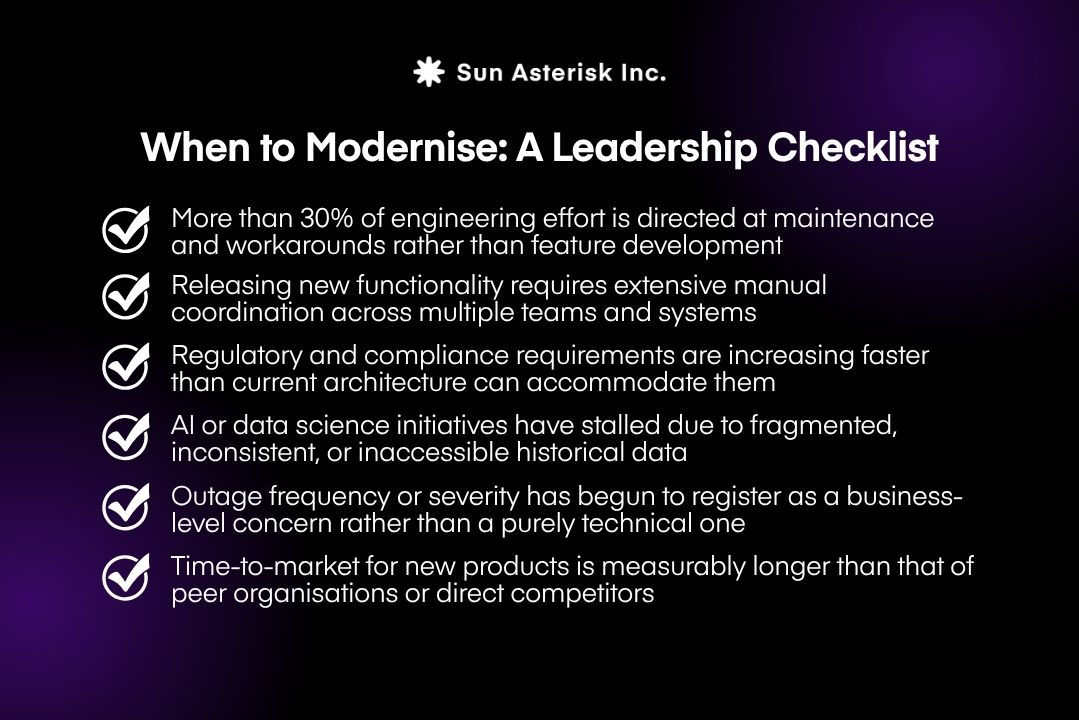
Trigger Points for Modernization
Modernization is rarely an all-or-nothing decision. In many cases, the challenge is determining whether existing systems continue to support the organization’s objectives or are gradually becoming a source of friction. The questions below can serve as a practical starting point for evaluating that balance.
Talk to our team.