In a world where our cars can predict a crash (tmi: not a Tesla – but a Volvo in 2008 was the first car manufacturer to introduce a production car with a comprehensive, constant crash-avoidance system) and our doorbells can recognize a delivery driver’s face, the gap in our hospitals is becoming impossible to ignore. We’ve moved past the “cool demo” phase of computer vision in healthcare and into a reality where “Ambient Intelligence” is becoming the silent co-pilot for our clinicians.
If you’ve felt the conversation in your boardroom shift from “is this AI safe?” to “how do we scale this across 50 facilities globally?”, you’re feeling the pulse of a $20B market pivot.
We aren’t just looking at X-rays anymore. We are looking at “visual infrastructure”—a way to solve the 2026 staffing crisis by giving every nurse a “digital pair of eyes” that never blinks, never gets tired, and never forgets to check a patient’s fall risk.
So, here’s a question for you: if computer vision can keep us safe on the highway and track our groceries at the store – where in your AI clinical workflow is “human sight” currently the biggest bottleneck?
Whether it’s ambient vision sensors that act as a permanent set of eyes on at-risk patients or real-time surgical intelligence that guides a resident through a complex procedure, computer vision has transitioned from a “cool-to-have” innovation project to a critical healthcare infrastructure investment.
In this guide, we’re going to look at the 5 non-negotiable trends and strategic “whys” computer vision should be on your 2026 roadmap if you want to turn visual data into a measurable clinical and financial moat.
Key insights
In 2026, computer vision in healthcare is no longer a pilot—it’s critical infrastructure.
- CV has evolved into a $20B+ visual nervous system for hospitals, moving from niche diagnostics to core operational infrastructure.
- The focus has shifted to surgical intelligence and patient flow, using AI to solve the 2026 staffing crisis without increasing headcount.
- Leaders now use physically accurate synthetic data to bypass privacy bottlenecks and train models on rare clinical “edge cases.”
- Real-time surgical guidance now runs on Edge-AI, providing sub-millisecond latency that cloud processing can’t match.
- 2026 models are context-aware, analyzing pixels alongside EHR data to provide “reasoned” clinical insights, not just image flags.
Why computer vision (CV) is your new healthcare infrastructure investment?
Think about the sheer volume of visual data moving through a 500-bed hospital on any given Tuesday. Between pathology slides, bedside monitors, surgical feeds, and high-res radiology, we are talking about a trillion-pixel ecosystem.
For a long time, we treated computer vision in healthcare like a specialized tool: a “second pair of eyes” tucked away in the radiology basement to help spot a tiny lung nodule.
But in 2026, CV has moved out of the darkroom and into the hallways. It’s no longer a niche diagnostic aid; it’s becoming the visual nervous system of the entire hospital.
Need proof? Let’s look at the hard numbers
If you’re wondering why your peers are shifting budgets toward visual AI, the market data tells a very loud story.
According to recent reports, we aren’t just seeing “steady growth”—we are seeing an explosion.
- The valuation leap: The global healthcare CV market is currently sprinting at a CAGR of nearly 40%. At this rate, we are on track to cross the $20 billion valuation mark by 2030.
- The operational shift: Here is the real 2026 insight: while “Diagnostic CV” (radiology and pathology) still holds a massive share, the fastest-growing segment is now Operational CV. We are seeing a massive capital pivot toward surgical assistance, patient flow monitoring, and “Smart OR” integrations.

CV solves your 2026 staffing wall
We’ve hit a wall. “What wall?” – you might ask.
It’s the global healthcare staffing crisis. It isn’t just a “challenge” anymore—it’s a breaking point.
We simply don’t have enough human eyes to monitor every bedside, every hand-washing station, or every surgical tray.
This is where the strategic “why CV in healthcare organizations” becomes clear: CV is the only way to scale “eyes on patients” without scaling headcount.
When you look at the numbers, CV isn’t just an “innovation” line item; it’s an efficiency play. If a camera in an ICU can passively detect a patient attempting to climb out of bed before they fall, that’s one less emergency, one less insurance claim, and one less exhausted nurse running down a hallway.
5 non-negotiable computer vision in healthcare trends for 2026
Let’s be honest: in a high-stakes clinical environment, “accurate enough” stopped being acceptable years ago.
In 2026, CV is the operating system for precision.
Whether it’s in the pathology lab or the surgical suite, embedding CV into our workflows does three things at once: it slashes the margin for human error, accelerates life-saving decisions, and finally gives us a fighting chance against the rising tide of chronic diseases through early, automated detection.
Say goodbye to data scarcity with the rise of synthetic data
For years, the biggest STOP sign in healthcare AI was the lack of diverse data. How do you train an algorithm to recognize a one-in-a-million surgical complication if you only have three recorded examples?
In 2026, we don’t wait for those rare cases to happen—we build them.
Real-world data is no longer the gold standard; Synthetic Medical Data is. We are now using generative AI to create physically accurate, “digital twin” anatomy to train models.
This “plastic data” allows us to cover every edge case imaginable, ensuring your CV models are “battle-tested” before they ever touch a real patient.
Early adopters are seeing a direct performance boost. For example, integrating synthetic images into ultrasound training sets has been shown to jump diagnostic accuracy from 88.7% to over 92%. By the end of this year, it’s estimated that 60% of all AI training data will be synthetically generated.
Edge-AI in the operating room (OR): sub-millisecond intelligence
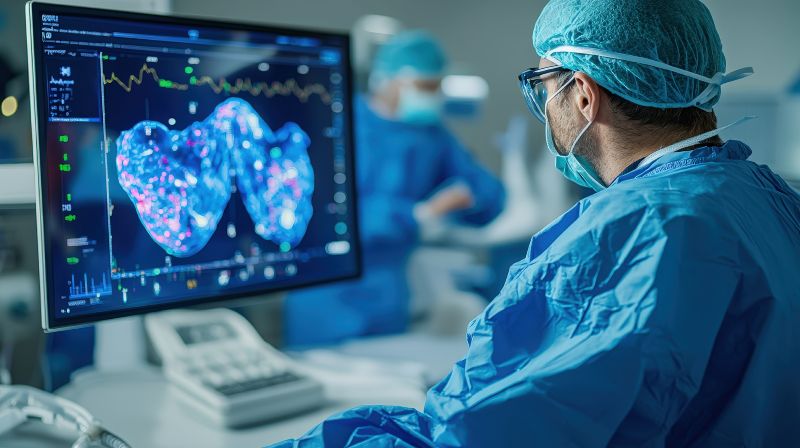
In the OR, “latency” is a four-letter word. You can’t wait 500 milliseconds for a cloud server to process a video feed and tell a surgeon they are too close to a critical nerve.
The 2026 shift is all about Edge-CV. We are moving the “brains” of the AI directly onto the surgical hardware.
By processing pixels on-device, we’re achieving the sub-millisecond speeds required for real-time surgical guidance—tracking blood loss in a sponge or identifying anatomical landmarks as they move.
If it isn’t “on the edge,” it isn’t in the OR.
Intraoperative guidance (the AI that “navigates” during surgery) now commands nearly 34% of the surgical AI market. Why? Because it reduces life-threatening complications like over-bleeding or nerve damage by providing real-time anatomical “GPS” with zero lag.
The rise of ambient patient intelligence
We’ve moved past the “image” and into the “environment.” Ambient Intelligence is perhaps the most significant “staffing multiplier” of the year.
Instead of asking a nurse to check every room every 30 minutes, 2026-grade CV acts as a passive, non-wearable sensor. It monitors for fall risks, detects early signs of pressure sores by tracking patient movement, and even flags silent “distress” signals.
It’s the ultimate safety net by giving your team “eyes everywhere” without the privacy-invading feel of traditional surveillance.
Ambient intelligence tools are currently saving clinicians an average of 20% of their daily documentation time, allowing them to focus on the patient rather than the keyboard.
AI that reads and sees with multi-modal vision-language models (VLM)
In the past, our CV models were “siloed.” One looked at a CT scan, while a separate LLM looked at the patient’s chart.
Well, not anymore.
In 2026, the state of the art is multi-modal.
The VLM market has reached $4.69 billion this year, growing at a steady 25% CAGR.
These Vision-Language Models (like the latest iterations of Med-SAM) can “look” at an MRI and simultaneously “read” the patient’s last three years of EHR notes.
The result? A diagnosis that isn’t just a pixel-match, but a context-aware clinical insight. It’s the difference between saying “There is a shadow here” and “Given this patient’s history of Stage 2 hypertension, this shadow likely indicates X.”
Privacy without the bottleneck
The “Data Privacy vs. Innovation” war finally has a truce, and its name is federated learning.
To solve the GDPR and HIPAA headaches that used to kill cross-institutional research, we are now bringing the model to the data, not the other way around.
In 2026, you can train a world-class CV model across ten different hospital systems without a single patient byte ever leaving its home facility. It’s decentralized, secure, and (most importantly for decision-makers) it eliminates the legal red tape that used to stall deployments for years.
The federated learning market in healthcare is valued at $41.5 million in 2026 and is the primary strategy for 67% of organizations currently piloting AI.
 The 2026 leadership playbook: How to move from “pilot” to “profit”
If you’ve made it this far, you’re likely convinced that computer vision in healthcare is no longer a “someday” technology. It’s here.
But as many of us have learned the hard way over the last few years, having great tech is only 20% of the battle. The other 80% is the strategy behind how you deploy it.
2026 is not another year for “move fast and break things” era of AI. We are in the era of clinical-grade execution.
Below is the strategic advice we’ve been working with healthtech leaders this year.
Stop building, start integrating
It’s tempting to want to build your own proprietary models from scratch because it feels like building an asset.
But in 2026, the “algorithm” is becoming a commodity. Your real value lies in AI multi-agent orchestration.
Don’t waste your engineering budget rebuilding what’s already available off-the-shelf.
Instead, look for interoperability-first platforms. If your CV solution doesn’t have a native, bi-directional conversation with Epic, Cerner, or your PACS, it’s going to become an expensive digital paperweight.
Your goal isn’t a “cool app”; it’s a seamless extension of the existing clinical workflow.
Prioritize Explainable AI (XAI)
The 2026 regulatory landscape from the FDA and EMA has made one thing very clear: if you can’t show your work, you can’t use the tool.
Before you sign off on a new CV vendor, ask their engineers: “Why did the model flag this specific lesion?”
If the answer is “the neural network just knows,” walk away. Your legal and compliance teams won’t let a “because the AI said so” diagnostic tool near a patient.
You need Explainable AI (XAI) that provides heatmaps or feature-attribution so clinicians can verify the “why” behind the “what.”
Invest in the data pipeline, not just the model
Your healthtech strategy will show you the best results, faster, with access to high-fidelity, diverse, and synthetic datasets.
Stop obsessing over model architecture and start investing in your ability to feed that model. Whether it’s through federated learning partnerships or synthetic data generation, your ability to provide “clean, rare, and representative data” is what will actually move the needle on accuracy.
Focus on the frictionless workflow
Here is a hard truth we’ve all seen play out: a 99% accurate tool will fail if it adds three clicks to a surgeon’s day.
In 2026, the best computer vision is the kind your staff doesn’t even realize they’re using. It should be “ambient.”
It should be the surgical guidance that appears naturally on the monitor, or the patient-risk alert that pops up directly in the nurse’s existing dashboard. If your tool requires a separate login or a new tablet, you’re fighting an uphill battle against user adoption. Design for zero friction, or don’t design at all.
To conclude
By the end of this decade, a hospital without integrated computer vision will be as obsolete as a hospital without an internet connection. We are moving toward a world where “sight” is a digital utility—one that makes our clinicians more human by removing the mechanical distractions of their jobs.
So, what’s your first move?
If you’re ready to see how these trends look in practice, we’d love to help you with your CV integration checklist for your technical team to ensure your next investment is 2026-ready.