At Sun*, we believe that world-class engineering isn’t just about writing clean code; it’s about building solutions that work in the real world.
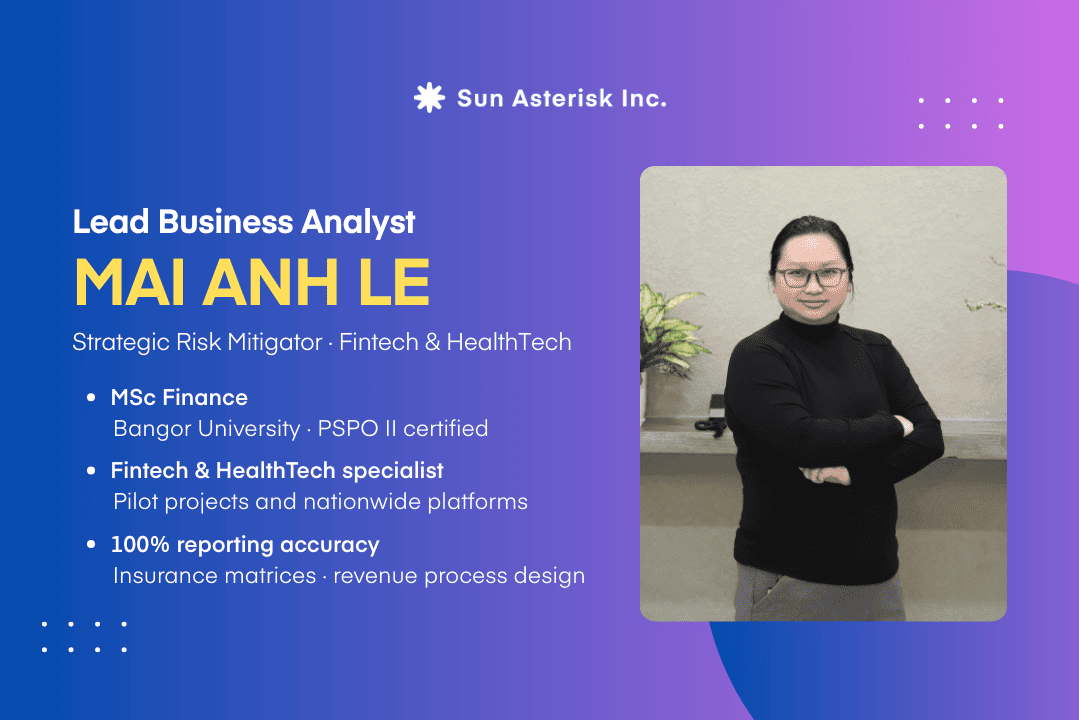
At the center of that process is Mai Anh Le, a Lead Business Analyst who goes far beyond gathering requirements. Her role is to understand how a client’s business truly operates, uncover the real problems behind the request, and translate those needs into solutions that the engineering team can successfully deliver.
With over 8 years of experience across fintech and high-stakes digital transformations, Anh has built a reputation for navigating complex business logic and fragmented data environments. Acting as the bridge between client stakeholders and technical teams, she ensures that what gets built reflects what the business actually needs.
Whether she’s reverse-engineering undocumented pricing rules or clarifying ambiguous workflows, her approach remains the same: healthcare workflow mapping before touching the software.
A Modern Lead BA’s Mindset
In the high-stakes world of digital evolution, Mai Anh Le has redefined the role of a Lead Business Analyst from a simple requirements-gatherer into a Strategic Risk Mitigator.
With nearly a decade of experience navigating the mathematical efficiency logic of fintech and healthcare, she approaches every project with a veteran’s manifesto: technology only succeeds when it first masters the human workflow.
Her work often bridges the gap between intricate medical workflows and enterprise platforms, ensuring that data mapping, whether for a routine health check or a specialized treatment flow, never compromises the clinical safety or operational flow of the system.
Healthcare Workflow Mapping: Why We Start With People, Not Platforms
Healthcare workflow mapping is the foundation of every clinical software project at Sun*.
Before architecture decisions, before sprint planning, our BA team documents who does what, in what sequence, and where handoffs break down — because software built on an unmapped workflow will always fail adoption.
When Mai Anh describes healthcare projects, she does not start with architecture. She starts with a human workflow.
“Healthcare isn’t just software,” she says. “It’s a fragmented ecosystem – IoT devices, legacy systems that predate half the team, data mapping challenges that can consume entire sprints on their own.”
But the real challenge isn’t technical. It’s the users. You are designing for medical professionals. You cannot digitalize a process until you have mastered the physical workflow and operational nuances of a clinic.
This is not a philosophical preference. It is a methodology that has shaped how she approaches every healthcare engagement she has led.
Before a single feature is discussed, Mai Anh and our development team map the operational reality: who does what, in what sequence, with what information, and at what points does something go wrong.
Only then does the question of software become useful.
The consequences of skipping that step, she explains, are not always visible at launch. Only months later, they surface – when adoption stalls, when workarounds multiply, when a well-engineered system sits unused because it was built for a perfect pilot workflow rather than a real one.
The Ultimate BA Stress Test? A 60-Day Global Deployment
Among the projects that have defined Anh’s career, one stands apart: not for its scale, but for the precision it demanded.
The brief was a 60-day window to launch a new clinical service. The stakeholder group spanned Vietnam and Japan.
Two in-house IT teams had to coordinate under serious time pressure, and the technology itself, while standard in isolation, needed to do something that had not been done before in this context: pull diagnostic data from major hospitals, integrate it across mismatched schemas, and automatically generate structured health check outputs that clinicians could trust.
“The tech was standard,” Anh recalls. “But the logic was a beast.” The early weeks were not spent building. They were spent on healthcare workflow mapping — every data handoff point, every system boundary, every moment where a misinterpreted field could corrupt a downstream output.
By the time the engineering work accelerated, the team understood exactly what they were building and why each decision had been made.
They launched on time. More importantly, they launched correctly. This is one example of how Sun* approaches high-stakes delivery. 👉 Explore our project portfolio
Why Healthcare Domain Expertise Is Never Transferable By Default?
The assumption Mai Anh encounters most often: in clients, in new team members, and sometimes in the industry at large, is that experience in one area of healthcare transfers cleanly to another. It rarely does.
Data mapping for a routine health check is worlds apart from a treatment flow.
“Even if policies look similar on paper, the underlying software logic varies by specialty. Each domain has its own data flows, its own stakeholder constellation, its own points of failure. Misunderstanding a single term can break the entire downstream logic.”
The proliferation of different software platforms across healthcare facilities compounds this. Similar-looking policies are implemented in meaningfully different ways. A BA who assumes consistency will eventually collide with an edge case that unravels months of work.
Her antidote is relentless specificity at the start:
- Who uses this software?
- Which stakeholders does it touch?
- What portion of a medical worker’s daily workflow does it cover?
- Where does it hand off to another system, and what does that system expect?
“Answer those questions first,” she says, “and most of the other risks become manageable.”
This is the domain of the veteran analyst: not information retrieval, but problem strategy.
Knowing what not to build. Knowing which edge case will matter at scale. More importantly, a business analyst recognizes when a client’s stated requirement is actually a symptom of a deeper process failure that needs to be addressed first.
BA’s Take on AI in Healthtech: A Co-Pilot, Not The Captain
Mai Anh uses AI daily. She credits it with compressing research cycles that once took days into hours of structured exploration — a genuine advantage when entering a new clinical specialty or validating domain assumptions quickly. But she is precise about where it earns its place in the work, and where it does not.
“AI gives you answers, a business analyst ensures you’re asking the right questions, especially when clinical safety is on the line.”
The distinction is not about capability. It is about the kind of judgment that only comes from proximity to real problems: knowing which questions matter, which risks are acceptable to carry forward, and which client requirements are symptoms of a deeper process failure that needs to be resolved before any software is written.
5 Lessons for Navigating Complex Systems from a Lead Business Analyst
After eight years, across dozens of projects and three of the most unforgiving domains in tech, Mai Anh Le has arrived at a set of convictions that don’t bend to deadline pressure or client enthusiasm. They are not rules. They are the residue of hard-won experience, and they apply every time, without exception.
1. Healthcare workflow mapping starts with the human, not the technology.
No software succeeds that was built for an imagined workflow. Before a single feature is discussed, healthcare workflow mapping means understanding what the doctor, the nurse, the billing officer actually does: in sequence, in reality, on a difficult Tuesday. Digitalization that adds friction is not a transformation. It is a disruption in the wrong direction.
2. Integration is not a technical problem. It is a context problem.
Data from a lab machine, a hospital system, a legacy platform. None of it has value until it is positioned correctly within the story it belongs to. The engineer connects the systems. The BA defines what those connections must mean. Without that clarity, you are moving data, not delivering insight.
3. “Healthcare is healthcare” is the most expensive assumption in the room.
Every specialty has its own data flow, its own logic, its own edge cases. Therefore, the moment a team stops asking which specific workflow they are designing for and starts generalising, they have accepted a debt that will inevitably surface – always – at the worst possible moment.
4. The weeks that look slow are the weeks that matter most.
Every project that has gone wrong, she has seen to move too fast at the beginning. The mapping, the questioning, the refusal to accept the first version of the brief at face value – ultimately, that is not a delay. That is the work. As a result, the speed comes later, and it is real speed, precisely because the foundation holds.
5. AI accelerates research. Experience decides what to do with it.
A co-pilot needs a captain. The value of a senior BA in an AI-augmented team is not diminished; it is sharpened. Because now the question is no longer how fast you can find answers. It is whether you are asking the right questions in the first place. That judgment cannot be prompted. It has to be earned.
Find your healthcare IT outsourcing partner at Sun*
Mai Anh Le is one of many experts and engineers at Sun* who are building technology products that make a real difference in healthcare, fintech, and every domain that demands deep systems thinking.
If you’re looking for a dedicated team ready to go the distance with you, from the very first question to launch day 👉 Talk to our tech experts.