For years, artificial intelligence (AI) has promised to transform clinical operations, but most implementations delivered tools that merely assisted human work.
They are about making tasks slightly faster but not fundamentally different.
AI-powered search engines helped clinicians find information. Predictive text accelerated documentation. Voice recognition reduced typing. But our humans still performed the core work.
That paradigm is shifting. In 2026, leading healthcare organizations are transitioning from assisted AI to agentic AI: systems that don’t just help humans complete tasks but autonomously execute entire workflows from start to finish.
Instead of a documentation assistant that suggests phrases, agentic AI listens to clinical encounters, understands context, generates complete notes, codes appropriately, and submits billing.
All without clinician intervention beyond final review.
However, the transition from assisted to agentic AI isn’t automatic. It requires strategic planning, phased implementation, organizational change management, and technical infrastructure that many healthcare organizations lack.
We’re going to discuss the roadmap that provides a practical guide for leaders navigating this transformation: understanding where you are, where you need to go, and how to get there systematically.
Key insight
Healthtech leaders are on the way to the evolution of clinical operations from assisted AI—tools that merely support human tasks—to agentic AI, systems capable of autonomous, goal-oriented workflow execution. Ultimately, the shift to agentic workflows transforms AI from a passive documentation aid into a proactive team member, fundamentally modernizing the healthcare operational model for 2026 and beyond.
Understanding the maturity spectrum
Understanding where your organization sits on the AI maturity spectrum is essential for planning your transition.
Healthcare AI adoption follows a predictable progression through 5 distinct levels (that you might be very familiar with):
Level 1-2: Manual to assisted AI (the Copilot model)
Most healthcare organizations in 2024-2025 operate at this level. AI functions as a copilot—providing suggestions, accelerating tasks, and offering decision support, but humans remain firmly in control of execution. Examples include:
- AI-powered clinical search engines that surface relevant research
- Predictive text in EHR documentation that suggests common phrases
- Voice recognition that transcribes dictation
- Clinical decision support that flags potential drug interactions
- Chatbots that answer basic patient questions
The value is real but limited.
These tools make existing workflows 10-30% faster, but they don’t fundamentally change how work gets done. Clinicians still write notes, staff still make phone calls, and administrators still process authorizations.
The human does the work; AI just makes it slightly easier.
Level 3-4: Semi-autonomous to Agentic AI
This is where the transformation accelerates.
At Level 3, AI handles complete tasks with human oversight—ambient documentation that generates entire notes, automated prior authorization that submits requests without staff intervention.
At Level 4, AI operates with goal-oriented autonomy across multi-step workflows:
- Autonomous care coordination agents that schedule appointments, communicate with specialists, arrange transportation, and follow up—all without human involvement beyond initial goal-setting
- Self-managing population health systems that identify care gaps, reach out to patients, schedule visits, and document interactions
- Intelligent revenue cycle agents that handle prior authorizations, appeals, and patient billing inquiries end-to-end
The shift is profound: AI is no longer a tool humans use but a team member that executes independently.
Now: humans set objectives, provide oversight, and handle exceptions—but don’t perform routine execution.
Level 5: Multi-agent orchestration (looking at the 2027-2028 horizon)
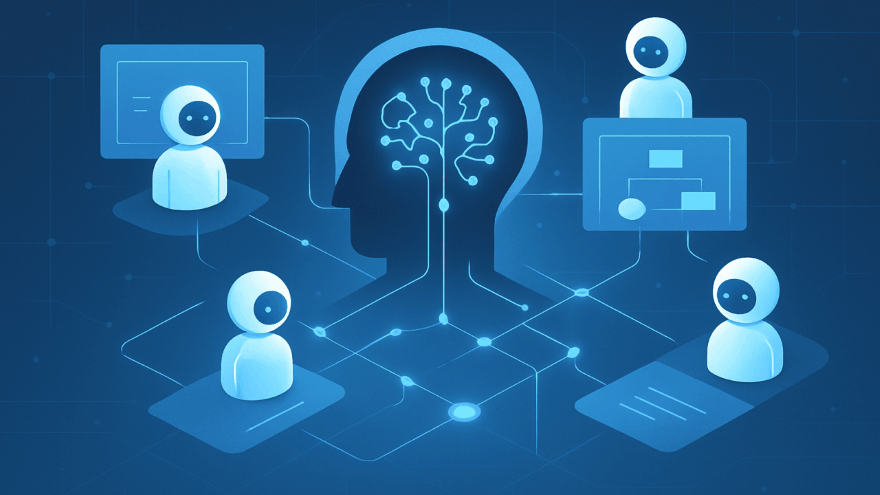
The emerging frontier involves networks of specialized AI agents working together: a documentation agent collaborating with a care coordination agent and a population health agent to manage a patient’s entire care journey autonomously.
These systems don’t just execute tasks; they reason, plan, adapt, and optimize continuously.
Most organizations won’t reach Level 5 until 2027-2028, but understanding this trajectory helps inform today’s architectural decisions.
The question isn’t whether to pursue agentic AI, but how quickly you can transition through these levels while managing risk and building organizational capability.
 Assessing your organization’s current state
Before planning your transition, you need an honest assessment of where you stand. Most organizations overestimate their AI readiness. Use this diagnostic framework to evaluate your current state:
Technology Infrastructure Readiness
- Do you have modern APIs and FHIR-compliant data exchange capabilities?
- Is your EHR cloud-enabled or on-premise only?
- Can you access real-time clinical data programmatically?
- Do you have compute infrastructure for AI workloads?
Organizations with legacy on-premise systems and limited API capabilities (most community hospitals) typically need 6-12 months of infrastructure work before agentic AI deployment. Those with modern cloud-based platforms can move faster.
Data Quality and Integration Maturity
- Is your clinical data structured, standardized, and clean?
- Do you have a unified patient identifier across systems?
- Can data flow bidirectionally between systems?
- How complete is your clinical documentation?
Agentic AI depends on high-quality data. Systems trained on incomplete or inconsistent data produce unreliable outputs.
If data quality is poor, foundation-building becomes your first priority.
Organizational and Cultural Readiness
- Do clinicians trust technology, or has past implementation trauma created resistance?
- Is there executive sponsorship for digital transformation?
- Do you have clinical informaticists who can bridge IT and clinical operations?
- How change-fatigued is your workforce?
Cultural readiness often determines success more than technology. Organizations with implementation fatigue from EHR transitions need careful change management.
Leadership should answer these questions before proceeding:
- What problem are we solving? (Specific pain points, not generic “efficiency”)
- Who will champion this? (Named executive sponsor and clinical champions)
- What’s our risk tolerance? (Determines pace and approach)
- How will we measure success? (Specific KPIs with baselines)
- What happens if we wait? (Competitive implications, clinician retention risk)
Common Starting Points by Organization Type:
- Large academic medical centers: Typically Level 2-3, strong technical infrastructure but complex governance
- Community hospitals: Typically Level 1-2, limited resources but often more agile
- Physician practices: Typically Level 1-2, highly motivated by administrative burden
- Digital-native health systems: Level 3-4, moving fastest toward full agentic operations
Understanding your starting point determines your roadmap. Don’t compare yourself to industry leaders at Level 4 if you’re realistically at Level 1—plan your journey accordingly.
The 4-phase transition roadmap
The transition from assisted to agentic AI isn’t a single implementation. In our view, it should be a multi-year journey through four distinct phases.
Each phase builds on the previous, creating organizational capability while delivering incremental value.
Phase 1: Foundation building (3-6 months)
Before deploying agentic AI, you need the technical and organizational prerequisites. This phase focuses on creating the conditions for success:
Core objectives: Modernize data infrastructure, establish integration capabilities, build stakeholder alignment, and identify high-value pilot use cases.
Key activities: Deploy FHIR-compliant APIs for data exchange. Implement cloud infrastructure if needed. Form an AI steering committee with executive, clinical, IT, and operational representation. Conduct vendor evaluations. Select 1-2 pilot use cases with clear pain points, measurable outcomes, and clinical champion support.
Success criteria: Technical infrastructure ready for AI integration, executive and clinical buy-in secured, pilot use cases selected with defined success metrics.
Common pitfall: Underestimating integration complexity. Budget 2-3x more time for EHR integration than vendors suggest.
Phase 2: Assisted AI deployment (6-12 months)
This phase deploys copilot-style AI tools that assist human work. The goal isn’t just operational improvement—it’s building organizational confidence in AI and establishing patterns for human-AI collaboration.
Core objectives: Achieve visible wins with assisted AI, train workforce on AI interaction, establish governance and monitoring frameworks.
Key activities: Deploy ambient clinical documentation in pilot departments. Implement AI-powered patient communication tools. Launch predictive analytics for care management. Create comprehensive training programs. Establish feedback mechanisms and continuous improvement processes.
Success criteria: 70%+ adoption rates among pilot users, measurable time savings (target: 20-30% reduction in documentation time), positive clinician satisfaction scores, demonstrated ROI on pilot investments.
Common pitfall: Inadequate change management. Technology works but adoption fails because clinicians don’t trust it or understand how to use it effectively. Invest heavily in training and champion development.
Phase 3: Semi-autonomous transition (6-12 months)
This is where the paradigm shifts. AI moves from assisting tasks to executing them autonomously with human oversight. This phase requires careful risk management and governance.
Core objectives: Deploy task-specific autonomous agents, establish oversight mechanisms, build trust in autonomous operations.
Key activities: Implement agentic care coordination for appointment scheduling and patient outreach.
Deploy autonomous prior authorization processing with exception handling. Launch automated results management and triage. Establish clinical governance committees to review AI decisions and outcomes. Create escalation protocols for edge cases.
Success criteria: 50%+ of target workflows handled autonomously, error rates below human baseline, clinical acceptance of autonomous operations, clear ROI demonstration.
Common pitfall: Insufficient oversight mechanisms. Organizations either over-control (defeating the purpose of autonomy) or under-monitor (creating safety risks). Find the right balance through structured governance.
Phase 4: Full agentic operations (12-18 months)
The final phase scales autonomous operations across the organization and integrates multiple agents into coordinated workflows.
Core objectives: Achieve goal-oriented AI autonomy across clinical and operational workflows, integrate multi-agent systems, establish continuous learning and optimization.
Key activities: Scale successful pilots organization-wide. Integrate agents across workflows (documentation + care coordination + population health).
Implement advanced analytics for predictive intervention. Build continuous learning systems that improve from feedback. Develop competitive differentiation through AI capabilities.
Success criteria: 60-75% reduction in administrative burden, measurable improvements in clinical outcomes, strong clinician satisfaction and retention, clear competitive advantage in market.
Common pitfall: Premature scaling. Organizations rush to expand before establishing robust governance, monitoring, and optimization processes. Scale methodically with continuous evaluation.
Timeline Reality Check
From start to full agentic operations typically requires 30-42 months. Organizations claiming faster timelines either started with exceptional infrastructure or are defining “agentic” loosely. Plan realistically and celebrate incremental progress.
Critical success factors you should check out for
Success in transitioning to agentic workflows depends less on technology selection than on six critical organizational factors.
Get these right, and technology challenges become manageable. Get them wrong, and even the best technology fails.
Executive Sponsorship and Governance
Agentic AI transformation cannot be delegated to IT. It requires C-suite commitment—not just budget approval but active sponsorship. The most successful implementations have:
- A named executive sponsor (often COO or CMO) who owns the initiative
- An AI steering committee meeting monthly with representation from clinical, operational, IT, finance, and compliance leadership
- Clear decision-making authority and escalation paths
- Protected budget that survives competing priorities
Without executive sponsorship, initiatives stall when they encounter organizational resistance or require difficult tradeoffs. With it, obstacles get resolved quickly.
Clinical Champions and Change Agents
Technology doesn’t transform workflows—clinicians do.
Identify influential clinicians who see AI’s potential and empower them as champions. The best champions aren’t necessarily the most tech-savvy but the most respected by peers.
Effective champion strategies include: dedicated time allocation (0.2-0.4 FTE), peer training responsibilities, input into vendor selection and workflow design, and visible recognition. Champions influence adoption far more than administrative mandates.
Data and Integration Strategy
Agentic AI is only as good as the data it accesses. Priority investments include:
- FHIR-compliant APIs for standardized data exchange
- Real-time data pipelines that provide current information, not yesterday’s batch updates
- Unified patient identifiers that link data across systems
- Cloud infrastructure for scalable compute and storage
The build-vs-cloud decision matters less than ensuring low-latency access to high-quality clinical data. Many organizations successfully run hybrid architectures with on-premise EHRs and cloud-based AI services.
Vendor Partnership Strategy
Few healthcare organizations should build agentic AI from scratch. Partner with specialized vendors, but choose carefully:
Evaluation criteria: Domain expertise in healthcare workflows, FHIR and EHR integration capabilities, transparent AI methodology with explainability, strong security and compliance posture, customer references with similar organizational profiles, and financial stability.
Contract considerations: Clear performance SLAs with remedies for non-performance, data ownership and portability provisions, transparency into algorithm changes, defined liability allocation, and realistic implementation timelines.
Avoid vendors promising unrealistic timelines or universal solutions. The best vendors acknowledge healthcare complexity and customize for your workflows.
Change Management and Training
Technology implementation succeeds or fails based on human adoption. Invest significantly in:
- Early and transparent communication about AI’s purpose, capabilities, and limitations
- Comprehensive training that goes beyond button-clicking to conceptual understanding
- Addressing anxiety directly about job displacement and loss of clinical autonomy
- Celebrating visible wins and sharing success stories
- Continuous feedback loops that give frontline staff input into optimization
Organizations that treat change management as an afterthought see 30-40% adoption rates. Those that invest heavily achieve 80%+ adoption and sustained engagement.
Measurement and Continuous Improvement
Define success metrics before implementation and track religiously. Key performance indicators should include:
- Efficiency metrics: Time savings, workflow cycle times, administrative burden reduction
- Quality metrics: Error rates, clinical outcomes, patient safety indicators
- Adoption metrics: User engagement, utilization rates, satisfaction scores
- Financial metrics: Cost savings, revenue impact, ROI
Establish feedback mechanisms that capture both quantitative data and qualitative user experience. Use insights for continuous optimization—agentic AI should improve continuously, not remain static after deployment.
The organizations succeeding with agentic AI excel at these fundamentals. Technology matters, but organizational capability determines outcomes.
To conclude
The transition from assisted to agentic AI isn’t optional. It’s the defining competitive dynamic in healthcare for the next five years.
Organizations that move decisively will secure significant advantages: dramatic reductions in administrative burden, improved clinician satisfaction and retention, better clinical outcomes through proactive care management, and financial performance that outpaces competitors.
The cost of delay is substantial. Every quarter without agentic workflows means continued clinician burnout, persistent administrative inefficiency, and competitive disadvantage as early movers pull ahead.
For healthcare leaders, the imperative is clear: start now.
Conduct your readiness assessment. Engage stakeholders. Identify pilot use cases. Select vendor partners. Launch your first implementations.