If you listen to how a lot of companies talk right now, you would think the big enterprise tech trends in 2026 and tech decisions are about which model to mention in the next board deck.
Pick a foundation model, sprinkle some agents, throw in a sovereign cloud slide, and boom, strategy.
Meanwhile the real engine that will decide whether any of this works — your architecture — is held together with old EDP commitments, overlapping SaaS, and a data layer that nobody fully trusts.
So instead of yet another generic trend list, let us talk about what the 2026 tech trends actually add up to for IT leaders: IT stops being facilities, and becomes the machine that executes business strategy.
Everything else is just special effects.
1. The real 2026 trend: architecture becomes a leadership problem
You can chase every AI trend on the planet and still lose if your architecture is a mess. That is the quiet truth sitting underneath every major 2026 tech forecast. Architecture is no longer a technical detail — it is something business leaders can no longer afford to ignore.
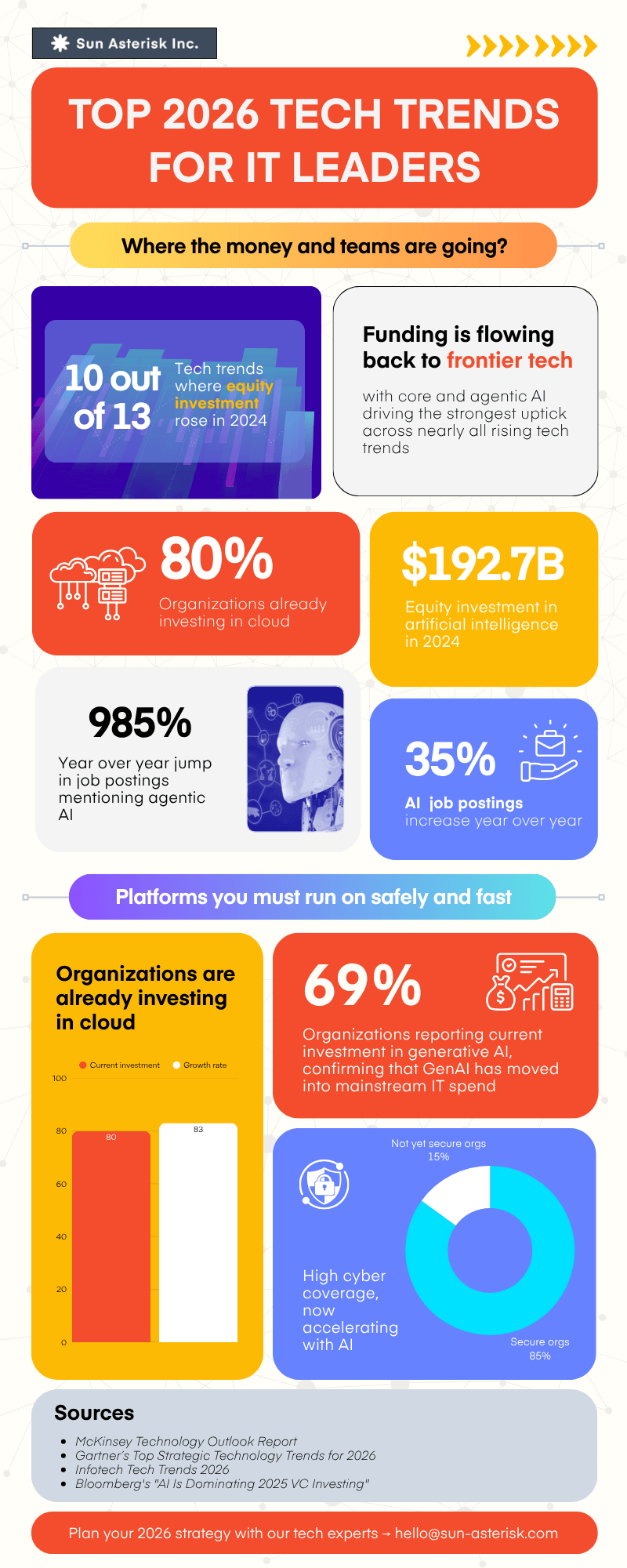 Look at the buzzwords that show up across the big 2025 and 2026 reports. Investment is already telling the story: 10 of the 13 major tech trends saw funding rebound in 2024 after the dip in 2023:
- AI-native development platforms
- AI supercomputing and app-specific chips
- Confidential computing
- Multi-agent systems
- Physical AI and robotics
- Digital provenance
- Sovereign cloud and geopatriation
- Exponential IT, service-as-software, federated data governance
None of those is “we bought a new app”. They are structural. They decide:
- How fast you can move
- How much you pay to move
- How badly it hurts when something breaks
If you treat them as a shopping list, your 2026 will be a very expensive year of PoCs that never quite add up.
Our takeaway:
In 2026, the top tech trend is not AI, not agents, not sovereign cloud.
It is IT leadership finally owning the architecture as a strategic asset, not a byproduct.
Everything else is just a test case.
2. Lock now: own your patterns or they will own you
Every team wants freedom until the consequences show up in security reviews and integration nightmares. Patterns are how you keep creativity from becoming chaos.
If you do not choose the defaults now, the defaults will choose you later, usually at the worst possible moment.
There is a charming myth that still lives in boardrooms:
“We do not want to over-standardize. Let teams pick whatever AI tools help them innovate. We are agile.”
Sound familiar? In practice, that looks like this:
- Team A: buys a SaaS co-pilot on Vendor X
- Team B: builds with Model Y on hyperscaler Z
- Team C: rolls their own thing on a GPU cluster a vendor spun up for them
- Security: finds out later
- Finance: finds out when the credit card bill arrives
You get lots of demos. Lots of “we are experimenting”. Also, lots of duplicated costs, security surface, and compliance reviews.
Here is the simple version in numbers.
| When every team chooses its own stack | When you define sane defaults |
|---|---|
| Five stacks across five teams | One shared AI platform pattern |
| Five security reviews | One security pattern to harden |
| Five data integration jobs | One federated data model |
| Five legal and compliance checks | One governance workflow |
| Five sets of vendor risk | One risk posture to manage |
| Fast demos, slow scaling | Fewer demos, real scale |
| Everyone feels clever | Everyone moves faster |
What to actually lock in 2026
Most teams waste half their year debating tools they will replace anyway. The trick in 2026 is not to control every choice but to control the starting point.
When your defaults are solid, everything built on top of them stays predictable, secure, and far cheaper to operate.
- Pick a default AI stack
-
- One or two primary platforms for model hosting, evaluation, and monitoring
- A shared set of guardrails and policies that apply to every AI workload
- Define a sensitive data pattern
-
- Which data is allowed near AI at all
- Which services handle that data (confidential computing, private endpoints, strict audit)
- What logs and controls are mandatory
- Choose your regions and sovereignty story
-
- Default regions for general workloads
- Special handling for regulated or national workloads
- A policy for when sovereign cloud or on-prem is required
- Create a small, hated, necessary architecture council
-
- Cross-functional: IT, security, data, product
- Mandate: protect the company from clever one-offs
If you do not make these decisions on purpose, you will still make them. You will just make them fast, during an incident, under stress, with a lot more lawyers in the room.
3. Pilot next quarter: ship internal platforms, not random tools
If 2025 was the year of buying shiny AI toys and it shows in the numbers: generative AI already has 69% enterprise investment with a 78% growth rate.
2026 needs to be the year you build something useful with them.
The fastest way to do that is by piloting small internal platforms that solve one real business outcome end-to-end. Once you have a platform, new capabilities feel like upgrades, not fire drills.
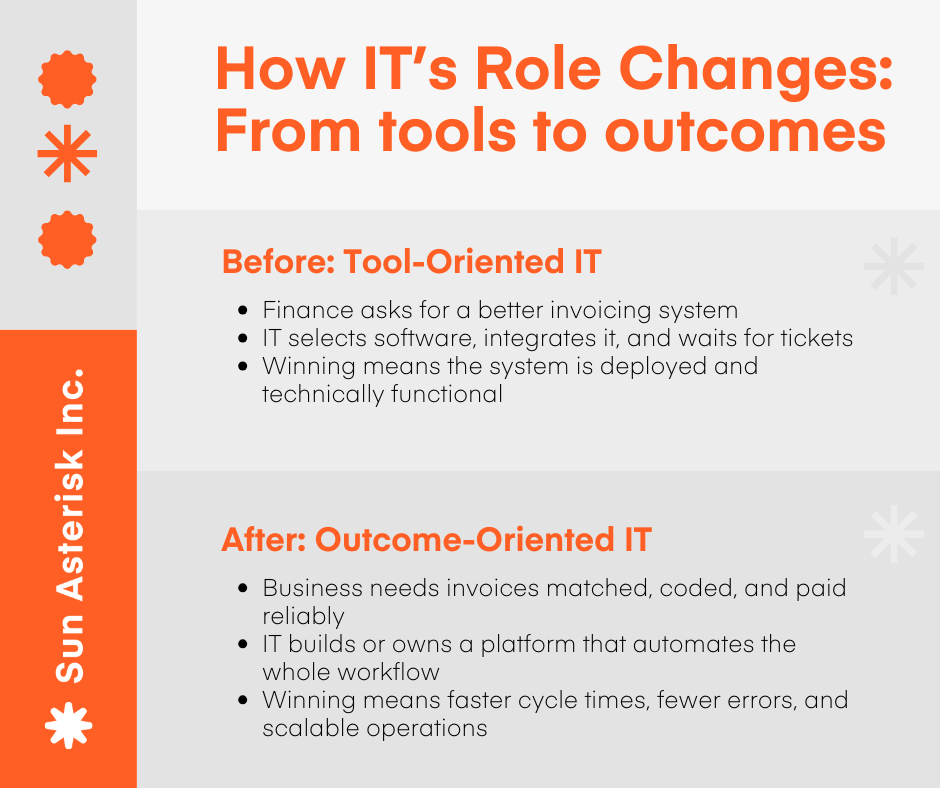
Most companies still treat IT like a slightly more technical version of facilities. Facilities hands out desks and chairs, IT hands out laptops and apps, and everyone pretends that is a sustainable operating model.
The problem is that this mindset locks IT into “support mode,” where the job is to keep the lights on instead of owning the outcomes the business actually cares about.
2026 enterprise tech trends quietly assume something very different. Exponential IT, service as software, AI native platforms, internal developer platforms. These are all saying the same thing:
IT is not the person who hands you a tool. IT is the team that builds the internal platform where the company does work.
Once you think this way, all the flashy AI trends actually make sense. Multi-agent systems become native parts of your internal platform instead of random bots taped to the workflow.
AI-native development lets your teams extend that platform fast, and service as software turns into a simple promise: you deliver a clear outcome for the teams that rely on you.
Where to run your first internal platform experiments
You do not need a 100-person platform team to start acting like one. The easiest way to begin is to pick one domain that actually hurts today. It could be IT support, employee onboarding, customer support triage, order-to-cash, field service dispatch, or any other place where work piles up faster than your teams can push it through.
Every company has at least one of these pain points. Start there.
Once you choose your domain, give it an owner. Not a ticket wrangler, not someone who “keeps the system running”. You need a person in IT or product who treats that space like a product with users, outcomes, and real accountability.
Next, define the outcome in one clean sentence.
Something simple like “New hires are fully provisioned and productive by day 3” or “Support requests are routed and answered within 2 hours”. If you cannot describe it simply, you cannot automate it either.
Then bring in AI only where it actually helps the platform. Agents can handle triage and classification. Gen AI can generate summaries, routing hints, and simple instructions. Traditional automation should cover anything predictable. Use AI as leverage, not as decoration.
Finally, publish one small dashboard. Just the basics: cycle time, volume, error rate. You are not doing it to impress anyone with fancy charts. You are doing it because platforms need feedback loops and leaders need proof that the engine is turning.
If you cannot find a single process in your company where IT can own the outcome instead of the tool, that is not a tech problem. That is a role problem, and it is the first one you need to fix.
4. Decide where your workloads live in a messy world
Another cozy myth:
“Cloud is basically infinite, and regions are details.”
That might have been true when your main risk was “instance not found”. It is not true in a world with:
- Energy constraints and power-hungry AI clusters
- Data protection rules with real teeth
- Export controls on chips and models
- Country-specific AI and content laws
- An ecosystem of sovereign cloud providers
Where your workloads live is becoming a strategic decision. If you treat it as “whatever the vendor default is”, you are outsourcing part of your risk management to the marketing department of a hyperscaler.
And this isn’t hypothetical.
Gartner expects more than 75% of European and Middle Eastern enterprises to shift workloads to regional or local providers by 2030, up from under 5% in 2025, purely because geopolitical mandates will force their hand.
This is where trends like geopatriation, sovereign cloud, and digital provenance stop being buzzwords and start being choices.
A simple workload and risk map
You do not need a 200-page strategy doc. You need a clear, slightly uncomfortable map.
| Question | What you’re evaluating | Why it matters |
|---|---|---|
| What data does this system touch? | Sensitivity, classification, cross-border exposure | Drives whether AI, cloud, or automation can touch it at all |
| What laws, contracts, or reputational risks apply? | GDPR, HIPAA, industry rules, customer commitments | Sets the boundaries for sovereignty and compliance |
| Where can it legally live? | Allowed regions and providers | Eliminates politically or legally risky options |
| Where should it live? | Power availability, latency, vendor concentration risk | Determines actual performance and resilience |
| How fast can we move it if we need to? | Exit cost, portability, data gravity | Prepares you for geopolitics, outages, or vendor failures |
5. Resilience is not a side quest
Here is the punchline: resilience used to be what you worked on after the real projects were done.
- Disaster recovery, tagged on at the end
- BCP binders, written once and left to age gracefully
- Security reviews, rushed before launch
In 2026, that will not survive contact with reality.
Supply chains wobble. Cloud regions go weird. Attackers use AI to scale social engineering.
The World Uncertainty Index has risen about 481% since early 2025, higher than during the COVID-19 peak.
Governments pass rules that sound like sci-fi. Users cannot tell real content from fakes.
Resilience is no longer a bonus. It is the environment.
So instead of treating resilience as an extra line item, build it into the architectural choices you are making:
- Federated data governance is not only for analytics. It lets you contain incidents and switch off specific domains when something goes wrong.
- Internal platforms are not only for productivity. They give you centralized control points when you need to flip the big red switch.
- Sovereign and multi-region strategies are not only for compliance. They are your spare engines when something fails for reasons outside your control.
The practical question to ask for any new system in 2026 is:
When, not if, this thing misbehaves or its environment changes, how quickly can we limit damage or move it.
If the answer is “we are not sure”, that system is not ready, no matter how clever the AI demo looks.
6. Your digital coworkers are coming, and they need a boss
Now for the fun part.
By 2026, a chunk of your workforce will not have payroll numbers and the demand is exploding. Job postings mentioning agentic AI jumped roughly 985% from 2023 to 2024.
They will be agents in ticketing systems, bots in back office workflows, and physical AI in warehouses and plants.
Good news: that is where a lot of the real productivity gains lives.
Bad news: most orgs are treating these things like features instead of coworkers.
When you see an AI agent as “a cool capability from Vendor X”, you do not give it:
- A clear scope
- Limits on what it is allowed to touch
- A named human supervisor
- A proper operational playbook
You just turn it on, say “look, it can click buttons for us”, and then act surprised when it does something weird at speed.
If IT wants to be the strategy engine, it has to own how these digital coworkers fit into the architecture and into the org.
Treat AI agents like teammates, not special effects
Treat agents like actual coworkers, not like some sparkly plug-in you slapped onto a workflow at 2 a.m. and hoped would behave.
If you hire a human, you give them a job description, boundaries, and a manager.
Do the same here.
Spell out what systems the agent can touch, what it is allowed to do without supervision, and what requires a grown-up to look over its shoulder.
And for the love of uptime, decide who gets their name on the incident report when the agent inevitably does something dumb.
Someone always answers for the mess, and pretending otherwise is how you end up explaining to the CFO why a bot bought a year of storage it did not need.
And once you “hire” these digital coworkers, you have to train them.
You update their prompts and rules the way you’d coach a junior analyst who tries hard but keeps wandering off the rails. You log their decisions, check their reasoning, and watch for drift as if you’re monitoring a sleep-deprived engineer.
This is where architecture and org design finally bump into each other: agents are just another class of user on your internal platforms. Treat them casually and they will repay you in equally casual disasters.
7. Explaining the tech strategy in your business terms
Sooner or later, you have to explain all this to people who do not care about embeddings or data lineage diagrams.
The translation is simple:
Fewer patterns mean less waste.
Platforms beat point tools because they tie spend to outcomes instead of vanity metrics.
A real workload location strategy saves you from regulatory and reputational headaches a TCO chart will never warn you about.
And resilience is not a budget add-on; it is the byproduct of choosing architectures that fail gracefully instead of dramatically.
Finally, agents are leverage, not chaos, but only if you define how they work and who is responsible for them.
Land even one of these points with numbers from 2025, and you stop sounding like the AI enthusiast and start sounding like the leader who actually keeps the place running.
Enterprise tech trends outlook: the uncomfortable but useful takeaway
Trend reports are fun. They are the tech version of watching trailers. Lots of energy. Very low consequence.
But if you are a tech leader reading this, the main question for 2026 is not:
“Which trend are we missing?”
It is:
“Who in this company truly owns the architecture that decides whether those trends help us or hurt us”
If the honest answer is “nobody in particular”, or “whoever our biggest vendor is this quarter”, then you already know your first priority.
Not another model.
Not another experiment.
Not another slide.
You need IT to stop acting like the department that keeps the lights on, and start acting like the machine that decides which lights exist, where they are wired, and who controls the switch.
In other words, treat IT as the strategy engine it secretly already is. The tech trends of 2026 are just giving you the excuse to say it out loud.