For decades, the healthcare industry has been engaged in a war of attrition against its own bureaucracy.
We have spent billions on Electronic Health Records (EHRs) and traditional Robotic Process Automation (RPA), yet the administrative burden continues to consume nearly 25% of total healthcare spending in the United States.
In 2026, the strategy has finally shifted. We are moving past “dumb” automation (yes, those bots that break the moment a user interface changes) to Agentic AI.
Working in healthtech projects for over 10+ years and with these AI updates for 5+ years, we are no longer asked “if” AI can help, but rather “what is the hard ROI of an autonomous agentic workforce?”
The answer lies in the transition from assisting humans to executing workflows.
By 2026, the agentic surge has hit a tipping point, primarily because these systems are not just tools. They are self-correcting, goal-oriented team members who protect margins in an environment defined by low reimbursement and high labor costs.
Key insights
To move beyond “pilot theater” and secure definitive agentic AI ROI in healthcare, leaders must prioritize execution over fluffy AI storylines:
- Leave the demos: Trade “we think it’s working” for execution-grade architecture built on autonomous decision-making and multi-step execution.
- Transform RCM: Achieve a 30–60% reduction in cost-to-collect and clean claim rates exceeding 95%.
- Clinical relief: Help reclaim your clinicians’ “pajama time” by cutting documentation by 60%, increasing daily patient throughput.
- Autonomous logistics: Slash inventory shrinkage by 7–10% using self-correcting supply chain agents.
- Future-proof margins: Secure a 15–20% cost advantage by 2029 through disciplined agentic orchestration.
Why Agentic AI ROI in healthcare is the core of your growth strategy?
Healthcare has spent billions on “dumb” automation, yet we are still losing the war of attrition against bureaucracy.
We have plenty of pilots and demos, but when the board asks for metrics, the answers are usually “we think it’s working.”
Well, later is here.
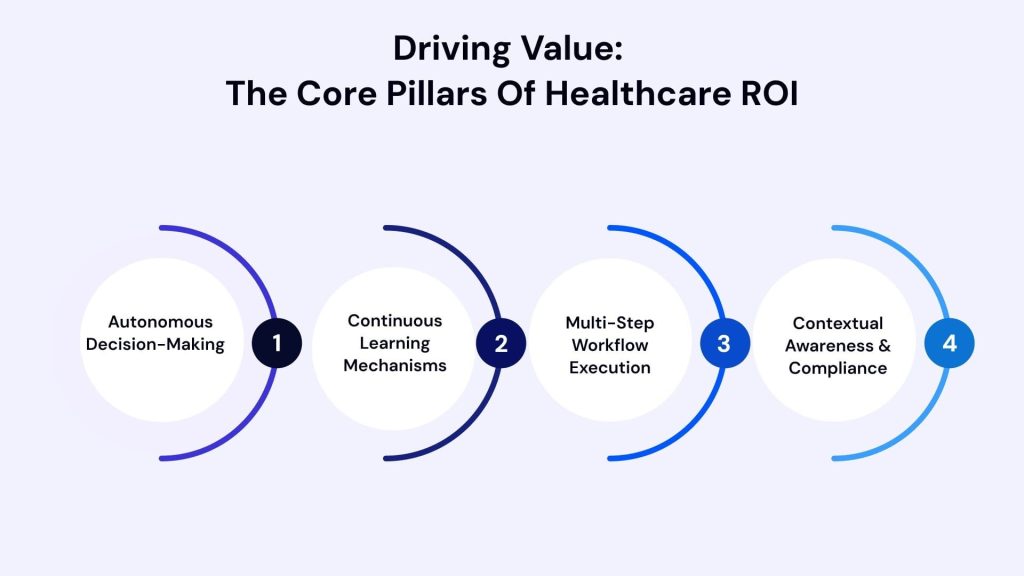
To move from storylines to assessments, we must anchor ROI in the 4 pillars of agentic value: Autonomous Decision-Making, Continuous Learning, Multi-Step Execution, and Contextual Awareness.
In the shift toward Agentic AI, ROI is no longer a byproduct of simple task automation but a result of these four architectural pillars.
We’ve moved beyond the old brittle RPA to Autonomous Decision-Making and Multi-Step Execution, where agents don’t just flag issues—they resolve them by navigating complex, cross-platform workflows.
By integrating continuous learning and contextual awareness, these systems maintain compliance and clinical integrity dynamically, rather than through static rules.
For healthtech leaders, this means shifting focus from managing technical debt to orchestrating an intelligent workforce that self-corrects and scales without increasing headcount friction.
Locking in a 30–60% agentic AI ROI in healthcare via the “touchless” revenue cycle
The most immediate and aggressive ROI for agentic administration is found in the Revenue Cycle Management (RCM) pipeline.
Traditional RCM is plagued by manual follow-ups and high denial rates. Agentic AI is fundamentally changing this by moving toward a “touchless” model.
Applying agentic AI to the revenue cycle can lead to a 30% to 60% reduction in the cost-to-collect.
Unlike standard RPA, an AI agent does not just submit a claim; it “reasons” through a denial.
It can autonomously parse a complex payer denial letter, cross-reference the clinical note in the EHR, identify the missing documentation, and resubmit the appeal without a single human touch.
- Clean claim rates (CCR): Early adopters are pushing clean claim rates above 95%, up from the industry average of 75–80%.
- Denial prediction: Agentic systems identify missing documentation or coding errors in real-time before submission, reducing initial denials by as much as 40% in high-volume specialties.
For a multi-billion dollar health system, moving the needle on clean claims by even 5% translates into millions of dollars in accelerated cash flow and a drastic reduction in the “days sales outstanding” (DSO).
Operational ROI: Supply chain and autonomous logistics
One of the most overlooked areas of agentic ROI we’ve seen is healthcare logistics.

In 2026, we are seeing agents manage the hospital supply chain with surgical precision. Traditional systems tell you when you are out of stock; agentic supply chain systems predict and resolve the deficit before it happens.
By 2026, the healthcare supply chain has moved decisively from experimentation to enterprise adoption.
Agents are taking on the transactional work of exception handling, price validation, and data reconciliation.
By analyzing real-time clinical data, such as a spike in respiratory admissions, alongside historical usage patterns, these agents autonomously adjust inventory levels, communicate with supplier APIs, and reorder supplies.
This autonomy reduces “inventory shrinkage” and stockouts, which typically account for ~10% of a hospital’s total operational spend.
When the system handles its own replenishment, you aren’t just saving money on supplies; you are reclaiming thousands of nurse hours previously spent hunting for equipment.
Reclaiming the “missing hour” to capture definitive Agentic AI ROI in healthcare
The “pajama time” crisis, aka where clinicians spend their evenings finishing documentation, is a massive hidden cost.
When a physician burns out and leaves, the cost to the organization is between $500,000 and $1,000,000 in recruitment and lost revenue.
Agentic AI delivers ROI here by closing the loop on clinical administrative tasks. Ambient listening was stage one; Agentic Clinical Workflows are stage two.
- Outcome: An agent doesn’t just draft the visit note; it queues up the prescribed labs, generates the referral letter to the specialist, and sends a summarized care plan to the patient’s portal.
- Fact check: Organizations using agentic documentation systems report a 60% reduction in time spent on notes, effectively reclaiming 2–3 patient slots per day.
By increasing throughput by just two patients per day, a primary care practice can see a revenue lift that pays for the AI infrastructure in less than six months.
Furthermore, with 82% of physicians reporting improved job satisfaction when these tools are implemented correctly, the retention ROI becomes a long-term financial cornerstone.
Patient experience as a revenue driver
In the competitive landscape of 2026, “friction” is the enemy of retention. It is predicted that by the end of this year, 40% of enterprise applications will feature task-specific AI agents.
For patients, this means 24/7 autonomous engagement that actually solves problems.
An AI agent doesn’t just “chat”; it acts.
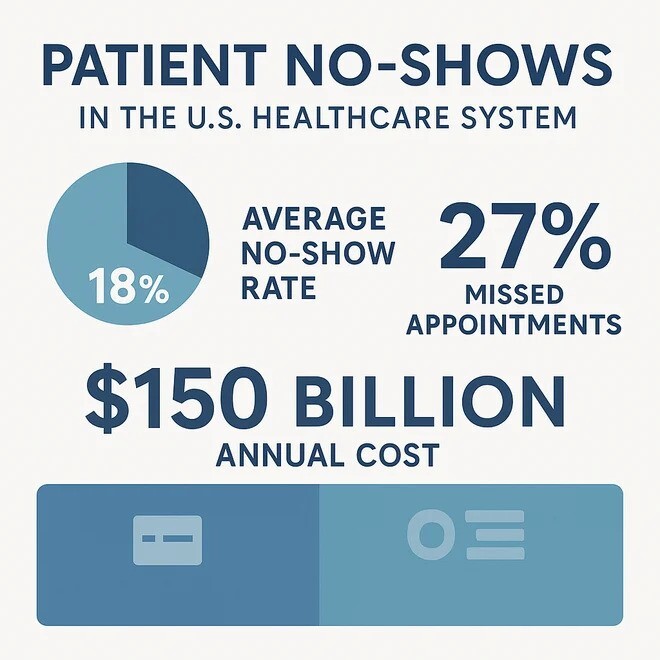
- Scheduling and triage: Agents use predictive analytics to identify patients likely to miss appointments and autonomously reach out via the patient’s preferred channel to reschedule or arrange transportation. This protects the $150 billion annually lost to no-shows in the U.S.
- Shorter wait times: By automating the intake and triage process, clinics are achieving 30-40% faster check-in times, leading to higher patient satisfaction scores and, consequently, higher reimbursement rates in value-based care models.
The TCO reality check for healthtech decision-makers: Investment vs. Return
The Total Cost of Ownership (TCO) for agentic AI is undeniably higher than traditional software. It requires a robust data foundation, including FHIR-compliant APIs, and a shift toward “inference computing” needs. However, the cost of inaction is higher.
Health systems that prioritize agentic AI in 2026 are expected to achieve a 15% to 20% cost advantage over their peers by 2029. Success is not measured by the number of pilots launched, but by the “disciplined orchestration” of these agents within core workflows.
Example of the agentic AI ROI in healthcare breakdown by timeline
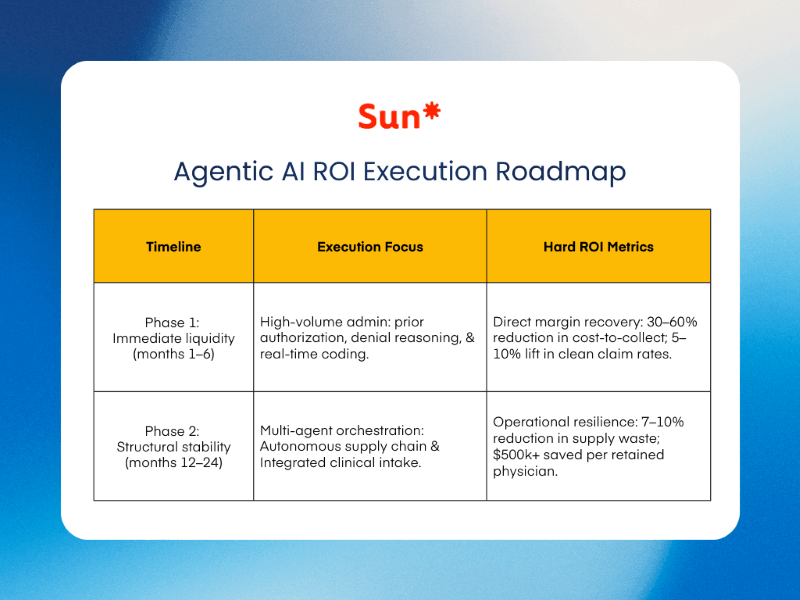
- Months 1-6: Focus on high-volume administrative tasks (prior authorization, denial management). ROI is realized through direct labor savings and accelerated cash flow.
- Months 12-24: Expansion into “multi-agent orchestration” (supply chain + clinical intake). At this stage, ROI is realized through operational resilience, lower supply waste, and significantly reduced clinician turnover.
Are you calculating the Agentic AI ROI in healthcare?
By the end of 2026, the industry will be split into two “worlds”. Those who used AI as a “search tool” and those who deployed it as an “execution engine.”
The latter are seeing measurable business outcomes in processing time, quality, and cost, turning their administrative back-office into a competitive weapon.
The transition to an agentic organization requires more than just a healthcare IT outsourcing vendor. It requires an architectural partner who can navigate the complexities of legacy integration and clinical-grade security.
📁 Most healthcare leaders tell us they think their AI integrations are “working.” When we look under the hood, they usually aren’t. The problem isn’t a lack of talent or quality. The problem is that they’ve built a collection of demos rather than an execution-grade architecture.
Ready to trade “we think” for “we know”? Sun* builds the execution-grade architecture that prioritizes hard metrics over hype. Connect with Sun* Execution Expert.