We read a lot about digital transformation in the wellness and healthcare industry. It is an important topic. But let’s be honest: most of it is noise – I mean, a collection of technical terms that don’t resonate with those of us managing the daily complexity of a healthcare organization. We often treat “digital transformation” as the goal itself, when it should be the means by which we execute a resilient healthcare growth strategy.
In 2026, that strategy is anchored in a $2 trillion global wellness market that is expanding far beyond traditional clinical categories.
Despite macroeconomic volatility, this sector remains remarkably resilient; for instance, 84% of US consumers now rank wellness as a “top” or “important” priority. However, when we flex our digital muscles without thinking through the ideal customer experience, we end up with high-tech tools like patient portals that suffer from single-digit adoption rates.
To turn wellness into a true growth engine, we have to look at the data.
Gen Z and millennials, who often self-report higher levels of burnout and stress, now drive more than 41% of annual wellness spend. They are looking for “Maximalist Optimizers”: science-backed, data-driven solutions that provide a “glow-up” to traditional, reactive sick care.
If our organizations don’t bridge the gap between clinical expertise and these daily, personalized practices, we aren’t just failing at digital transformation; we are missing the most significant healthcare growth strategy of the decade.
Key insights:
- The power of the “maximalist optimizer”: Gen Z and Millennials now drive 41% of annual wellness spend, prioritizing science-backed, daily practices over occasional clinical visits.
- From lifespan to healthspan: Consumer demand is shifting toward proactive longevity, functional nutrition, and metabolic health, creating a significant opportunity for organizations to increase Patient Lifetime Value (PLV).
- Addressing the “unmet need” gap: Despite the sector’s growth, consumers report significant unmet needs in mental health, cognitive function, and gut health. These are areas where integrated healthtech solutions can provide a distinct competitive advantage.
- Operational excellence over hype: Success in 2026 requires moving away from vague “interoperability” promises toward specific data reconciliation that connects home wellness tech directly with core clinical records
Trends shaping the future of wellness in healthcare growth strategy
There are many lists about “healthcare trends.” But in any year, a trend is only as good as the customer experience it enables. If we aren’t using these shifts to build a more resilient healthcare growth strategy, we’re just adding more legacy weight to our systems.
In our recent projects with wellness partners, we’ve seen a recurring theme: the market is defying the usual economic gravity. Even when consumers say they plan to cut discretionary spending, wellness categories remain protected.
Here is how we view the real-world application of these trends creates a competitive advantage, provided we stop treating them like “side projects” and start treating them like core business imperatives:
From “mental health” to proactive emotional fitness
We need to stop viewing mental health as a reactive service, which is something we only address when a patient is in crisis. By 2026, the real advantage lies in emotional fitness.
- Younger consumers, specifically Gen Z, report feeling “almost always stressed” at a rate of 40%, nearly double the general population.
- They aren’t just looking for virtual therapy; they are seeking tools for nervous system regulation, such as breathwork and somatic movement, as a daily practice.
- If your “healthcare integration” is just a link to a meditation app in a patient portal, we think you’ve failed the experience test. The goal is a seamless ecosystem where emotional resilience is built into every primary care touchpoint.
Radical personalization via biomarkers (not just SDOH)
We’ve talked about Social Determinants of Health (SDOH) for years, but the 2026 consumer (the “Maximalist Optimizer”) wants more than a community referral; they want data.
- They are looking for precision wellness driven by at-home biomarker testing, gut microbiome analysis, and real-time metabolic scores.
- This isn’t just about housing or income; it’s about providing functional nutrition that acts as preventative medicine.
As healthtech leaders, your job is to ensure this biomarker data isn’t just “siloed” in a vendor’s app but is reconciled directly into the clinical workflow so it actually informs care.
The shift to holistic “need states”
Patients don’t think in terms of “service lines”; they think in terms of how they feel. They are moving toward holistic care models like functional and integrative medicine because they want root-cause solutions.
- Consumers are now prioritizing healthspan, which means prioritizing mitochondrial health and inflammation reduction over traditional lifespan metrics.
By 2026, the most successful organizations will be those that “break barriers” between categories, bundling weight management with digital apps and live nutritionist consultations to solve a need state holistically.
Workplace wellness
If you want to know if your wellness strategy is ready for the external market, look at your own employees.
- Corporate wellness in 2026 has moved beyond simple gym stipends toward holistic well-being ecosystems.
- This includes “edutainment”—educational and engaging programming—and circadian-friendly office designs that prioritize restorative rituals.
If we can’t create an all-digital, frictionless wellness experience for our own staff, we have no business trying to sell it to a $2 trillion global market.
Moving beyond “sick care”: the 2026 longevity growth engine
People don’t just want to live longer; they want to live better. Yet, we have a massive gap in the industry.
70% of US-based adults are behind on at least one routine cancer screening. Preventive services are dramatically underused. This is the “clinical backlog” we keep talking about.
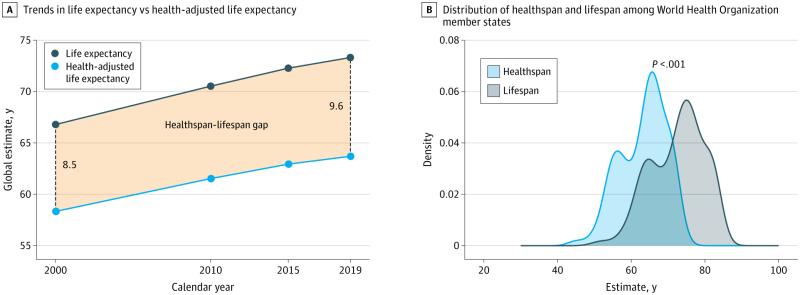
(source)
Looking at the graphs above: the widening gap between how long we live and how well we live represents the ultimate “unmet need” in our current healthcare growth strategy. While global life expectancy continues to climb, health-adjusted years are lagging, creating a nearly decade-long deficit in quality of life that our legacy “sick care” systems are failing to address.
For healthtech leaders, this 9.6-year gap is not just a statistic—it is a $2 trillion opening for proactive, data-driven longevity systems that prioritize healthspan over mere survival.
The competitive advantage in 2026 is precision prevention. It is the integration of clinical expertise with personalized digital experiences. Leading organizations are no longer treating wellness as an “add-on.” They are treating it as a growth engine by launching:
- Functional nutrition programs: Moving beyond generic diets to “bio-harmony” nutrition. These programs foster eating in alignment with circadian rhythms and metabolic needs.
- Metabolic flexibility clinics: Capitalizing on the GLP-1 boom by providing nutrient-fortified foods and muscle-preservation programs for patients on weight-loss medications.
- Healthspan services: Shifting from reactive care to proactive longevity, focusing on mitochondrial support and inflammation reduction.
Implementation blueprint: reconciling data, not technical terms
We often hear both leaders and vendors represent “tech upgrades” as “interoperable”. Honestly, we need to stop asking the “Interoperability Question.” Not because it’s bad, but it is too vague. When we talk about wellness as a competitive advantage, we need to be specific about what we are trying to solve.
In our experience, a successful wellness project doesn’t fail because the app or feature was “bad”. It fails because the data lived in a silo and never reached the clinician’s eyes in a way that was actually useful.
If you’re evaluating a healthcare IT outsourcing partner for 2026, don’t ask if they are interoperable; ask them how they plan to reconcile a “real-time metabolic readiness score” with a patient’s existing medication list in your core EHR.
If a B2B healthtech partner tells you their wellness app “integrates” with your core EHR, don’t simply take their word for it. Ask:
- How will the biomarker data from this wearable automatically reconcile with the patient’s clinical record?
- Where have you successfully done this with a legacy system like ours?
- What is the specific workflow for a physician to act on a “real-time metabolic readiness score” without adding four hours to their charting day?
Those of us who are clear about the problem we are trying to solve—increasing Patient Lifetime Value (PLV) through continuous engagement—will have the most success.
We shouldn’t be building tools that exist in a silo; we should be building integrative solutions that connect products, services, and digital tools to solve need states holistically.
Stop investing in silos. Start building a growth engine.
Vague promises of “interoperability” are the fastest way to single-digit adoption rates. Our 2026 Healthtech Implementation Blueprint provides the exact technical and operational framework required to reconcile real-world wellness data with clinical excellence. Contact us.
Internal customers first
Here is a suggestion for healthcare IT and business leaders: before you try to revolutionize the external patient experience, look at your internal customers.
What is your organization’s customer experience when onboarding a new employee? Is it a “digital-first” experience that respects their time? If we can’t create a well-designed, non-redundant front-end for our own staff, why do we think we can do it for a “Maximalist Optimizer” who expects the same level of service they get from a luxury travel planner?
Show your organization that you have the vision to create a model for external excellence by starting with the internal ecosystem. Use your own “workplace wellness” as a testing ground for “edutainment” and circadian-friendly office design.
If your staff is thriving because of the wellness tools you’ve implemented, they become your best brand ambassadors.
Turning wellness into your competitive healthcare growth strategy
Wellness in 2026 is not about chasing the next big fad. It is about building sustainable, science-informed habits that fit into real life.
To win, healthcare organizations must:
- Break barriers: Stop thinking in silos. Wellness is about consumer “need states” like energy, gut health, and sleep.
- Emphasize expertise: Leverage your clinical brand to provide the “science-backed” validation that consumers are desperately seeking.
- Deliver real value: Value isn’t just about the lowest price; it’s about efficacy and availability.
Healthier patients are more loyal customers. By shifting your focus to proactive longevity and personalized daily practices, you can turn the current market tailwinds into a sustainable, long-term competitive edge.
