Banking mobile app development now defines the modern banking experience, serving as the primary and often only — way customers interact with their financial institutions.
The institutions pulling ahead are not the ones with the most features. They are the ones that made the right architecture decisions early, embedded security before it became urgent, and built delivery systems capable of shipping improvements every few weeks without breaking what already works.
Sun* has built and scaled mobile banking products across Japan, Singapore, and Southeast Asia — from a 50-person iOS build for JAL Mileage Life delivered ahead of schedule, to a Singapore eWallet processing 1 million transactions daily with 99.99% fraud detection accuracy.
This article draws on that experience. It covers what it actually takes to build a competitive banking app in 2026: the features that matter, the architecture decisions that shape everything downstream, the compliance requirements you cannot defer, and the delivery approach that separates teams that launch from teams that scale.
Key takeaway
- A mobile banking app is now the primary revenue and retention surface for most financial institutions — not a support channel. The institutions growing fastest treat it as a continuously evolving product, not a project with a finish line.
- Architecture and security decisions made in the first sprint determine what you can build in year three. Sun* has seen this play out across markets: teams that defer these decisions end up rebuilding under load, which is the most expensive way to learn the lesson.
- Speed and quality are not in tension if the delivery system is right. Sun* completed JAL Mileage Life — a banking, loyalty, and payments app for one of Japan’s largest airlines — with a 50-person team, ahead of schedule, using CI/CD pipelines that kept the product shippable throughout.
Is Your Mobile Banking Strategy Still Competitive?
Mobile technology has evolved from a mere banking channel into the bank itself. As of 2026, the paradigm for customer expectations has moved beyond simple access toward proactive intelligence. Rather than basic transactions like balance checks or transfers, modern users demand financial services that anticipate their requirements and offer background guidance.
This transformation elevates mobile app development from a digital project to a fundamental business strategy for financial institutions. Those who view mobile as essential infrastructure, rather than just an interface, are successfully driving growth.
At the same time, AI is shifting from a feature to a foundation. The apps gaining ground are not just faster or cleaner — they are learning systems that surface insights, flag anomalies, and personalise experiences in real time. Building for this capability is now an architecture decision, not a future roadmap item.
The ROI model has also flipped. Mobile is no longer justified by cost efficiency alone – it is a primary revenue engine. Data-driven cross-selling, contextual offers, and intelligent automation directly impact growth metrics.
The question for engineering leadership is no longer “how do we build the app,” but “how do we turn mobile into a continuously learning system that drives revenue.”
Mobile Banking: Must-Have Features and Frameworks
A banking application is one of the most technically demanding categories of software. It must be fast, reliable, and secure, simultaneously. It must handle sensitive transactions without error and surface complex financial data in a form that a non-technical user finds intuitive. And it must do all of this under regulatory scrutiny that few other software products face.
Before a single line of code is written, two questions need clear answers: what will this application do, and how will it be built?
What features does every banking app need as its foundation?
Every banking app needs to earn the basics before it earns trust. The foundation includes:
- Account management: real-time balance visibility, transaction history, multi-account support, and statement access. These are table stakes, but they must work flawlessly.
- Fund transfers: domestic and international transfers, peer-to-peer payments, and scheduled transactions. Speed and confirmation clarity matter here as much as reliability.
- Bill payments: utility payments, loan repayments, and top-ups. Integration with local payment rails and major service providers is essential for market relevance.
- Notifications and alerts: proactive communication about transactions, security events, and account changes. Done well, notifications build trust. Done poorly, they train users to ignore them.
- Customer support access: in-app chat, callback requests, and FAQs. The moment a user encounters a problem and cannot reach help is the moment they reconsider their choice of bank.
Beyond the foundation, differentiated banking apps are investing in a second tier of capabilities: AI-powered spending insights, goal-based savings tools, micro-investment features, and personalised financial health scores. These features deepen engagement and create switching costs that pure utility cannot.
Architecture decisions shape everything downstream
Technical architecture is not an implementation detail. It is a strategic choice that shapes how fast a banking product can evolve, how reliably it can scale, and how securely it can operate. Three decisions matter most.
First: native or cross-platform?
Native development — Swift for iOS, Kotlin for Android — delivers the best performance and deepest access to device features like biometrics and secure enclaves, but requires maintaining two codebases.
Cross-platform frameworks such as Flutter and React Native have matured significantly, now offering near-native performance for most banking use cases with the efficiency of a shared codebase. For many teams in 2025, Flutter is the pragmatic choice: strong performance, a growing ecosystem, and excellent support for the custom UI banking apps demand.
Second: microservices or monolith?
A monolithic backend is not inherently wrong. For early-stage products or lean teams, it is faster to build and easier to manage. The limitations emerge at scale — when services need independent deployments, traffic spikes affect unrelated features, and larger engineering teams require parallel workflows.
Microservices solve many of these problems but introduce others: distributed tracing, service discovery, inter-service latency, and operational complexity. The right choice depends not only on where the product is today, but where it is expected to be in three years.
Third: Open Banking and API integration.
Modern banking apps depend on integrations with core banking systems, payment networks, KYC providers, credit bureaus, and third-party financial services. Designing an API layer that is secure, flexible, and adaptable to future integrations is one of the most consequential architectural decisions a team will make.
Architecture principle: build for the scale you expect in three years, not the scale you need today. Refactoring architecture under production load is one of software’s most expensive problems.
Security, compliance and regulatory requirements
Rather than being a secondary feature, security serves as the bedrock for every other component of a banking application. When a platform manages actual currency, personal identities, and critical financial choices, security must be integrated from the start—not treated as a final audit, a post-release addition, or a mere regulatory checkbox.
The repercussions of security failures extend beyond monetary loss to severe reputational damage. One major breach has the potential to destroy years of established trust and, within regulated environments, trigger legal interventions that could jeopardize the institution’s very right to function.
Authentication that earns user trust
The authentication layer is the most sensitive part of any banking application. It must be rigorous enough to prevent unauthorised access and seamless enough that legitimate users are not frustrated into workarounds. The standard approach is layered:
- Biometric authentication: Face ID and fingerprint recognition are now expected by users and provide strong security with minimal friction.
- Multi-factor authentication (MFA): SMS OTPs remain common but are increasingly supplemented by authenticator apps and hardware tokens for higher-risk operations.
- Device binding: associating an account with a registered device adds a layer of protection that survives credential theft.
- Session management: automatic timeouts, re-authentication for sensitive actions, and anomaly detection on session behaviour round out a robust authentication posture.
Data security in depths
Implementing TLS 1.3 as the minimum standard ensures protection for data in transit, while AES-256 encryption with proper key management secures data at rest on both devices and cloud infrastructure. Certificate pinning prevents man-in-the-middle attacks that would otherwise be invisible to users.
Beyond technical controls, the principle of minimal data collection deserves emphasis. Applications that collect only the data they genuinely need have a smaller attack surface and a simpler compliance posture. It is a discipline that pays dividends long after the initial build.
Fraud detection and anomaly monitoring
Reactive security – detecting a breach after it happens – is necessary but not sufficient. Leading financial applications now deploy machine learning models that identify anomalous behaviour in real time: transactions that deviate from a user’s normal patterns, login attempts from unexpected geographies, or account activity at unusual hours. These models generate alerts that allow fraud teams to act before damage is done.
Navigating the regulatory landscape
Compliance requirements vary by market, and they change. Depending on where your application operates, you may need to align with PCI-DSS for payment card data, ISO 27001 for information security management, GDPR for user data involving European residents, or local central bank regulations governing electronic banking services.
The practical implication is that compliance cannot be addressed at the end of a project. Regulatory requirements shape product decisions, from data architecture to onboarding flows to audit logging and teams that engage with compliance requirements early build better products faster than teams that treat them as a constraint imposed from outside.
Regulatory requirements differ significantly across markets and are continuously evolving. Engaging early with legal and compliance specialists who understand your target jurisdiction is a necessary part of the development process, not an optional one.
From Scoping to Launch: How Sun* Sequences a Banking App Build
The biggest delivery risks in banking app development are not technical — they are sequencing failures. Teams that try to resolve architecture, compliance, and feature scope simultaneously consistently overrun timelines and incur expensive rework. Here is how we approach the sequence.
Scope before you design. Define the minimum set of features required to operate legally and serve users on day one. For most banking apps, this is: secure login, account management, payments and transfers, bill payments, and in-app support. Everything beyond this is a phase two decision.
Resolve architecture and compliance in parallel, before development begins. Stack selection, API design, and compliance mapping for your target markets (PCI DSS, GDPR, PSD2, local regulations) must happen together. A stack decision made without compliance context creates rework. A compliance scoping done after architecture is chosen creates constraints that are expensive to retrofit.
Build the security layer as infrastructure, not a feature. End-to-end encryption, biometric authentication, MFA, session management, and fraud monitoring are not additions to the app — they are part of the foundation. Teams that treat them as features tend to bolt them on late, which is where security debt accumulates.
Launch an MVP, then ship continuously. For JAL Mileage Life, a 50-person Sun* team delivered a production iOS app — integrating mileage management, JAL Pay, and multiple vendor SDKs — ahead of schedule. The delivery discipline that made that possible was the same principle that applies to any banking build: define a tight, shippable scope, instrument it from day one, and use real usage data to drive every subsequent sprint.
A banking app is never finished. The institutions that treat launch as a finish line fall behind the ones that treat it as the beginning of a continuous delivery cycle.
Sun* Banking App Case Study
The JAL Mileage Life project illustrates what this looks like in practice.
JAL needed a single iOS application to unify its expanding mileage programme, integrate JAL Pay, and connect multiple third-party vendor SDKs — all while maintaining robust security and a seamless user experience for millions of loyalty members.
Sun* assembled and led a 50-person development team based in Vietnam, coordinating across iOS, Java backend, and SDK integration workstreams simultaneously. The project was completed ahead of schedule.
The delivery outcome was not a consequence of scale alone — it was the result of a structured build sequence, CI/CD pipelines that kept the product shippable throughout, and rigorous risk management at every integration point.
Best Practices for Mobile Banking App Development
Are you thinking of updating or building your own banking app? Here’s what to look for and what to ask if you consider working with a product developer.
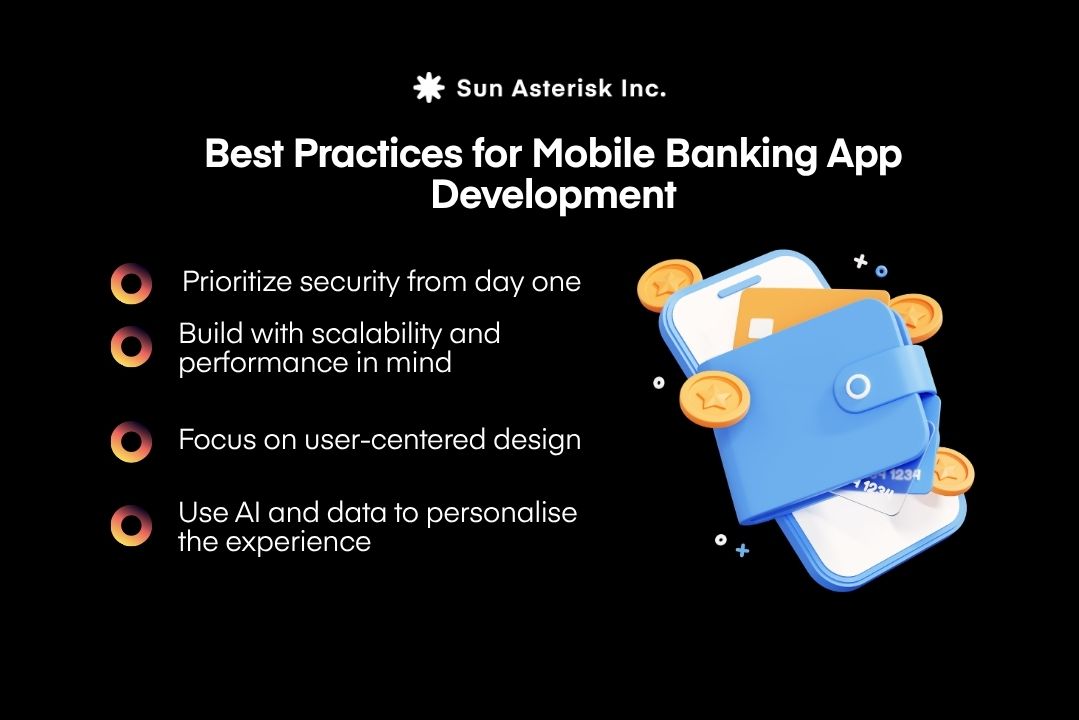
1. Prioritize security from day one
Security isn’t an afterthought. A mobile banking app must implement multi-factor authentication, strong encryption protocols, and continuous fraud monitoring to protect user data.
According to the European Central Bank, card-not-present fraud accounted for nearly 84% of all payment card fraud losses in Europe in recent years, highlighting the need for smart digital safeguards. The best practice is to design for security early – ensuring compliance with PSD2, GDPR, and PCI DSS from the start, not as a final checklist before launch.
How Sun* approaches this:
Security requirements are scoped in the architecture phase, before any code is written.
Compliance mapping — PSD2, PCI DSS, GDPR, local central bank regulations — happens in parallel with feature scoping, not after. Penetration testing and compliance audits are built into the delivery schedule as fixed milestones, not added at the end when they’re most disruptive to fix.
2. Build with scalability and performance in mind
What works for your first 50,000 users can become a serious liability at 500,000. Banks need systems that scale horizontally and handle high transaction volumes without latency or downtime — especially during peak periods like paydays or promotional campaigns.
Cloud-native architectures and containerised deployments allow for flexible, cost-efficient scaling as demand grows. Scalability is not a future concern to plan for later. It is a design decision made at the start.
How Sun* approaches this:
Scalability is designed from the architecture phase — not addressed when the first performance problem appears in production.
When a new banking product is scoped, the architecture conversation always includes: what does this system need to handle in three years, and what would a traffic spike on payday actually look like?
3. Focus on user-centered design
Great features fail if users cannot find or use them easily. Mobile banking apps should follow intuitive design principles, minimalist navigation, clear calls-to-action, and accessibility standards that work across devices and user demographics.
Studies show that financial apps are among the most frequently abandoned due to basic usability confusion, underscoring that simplicity is not a nice-to-have. A well-designed UX keeps customers engaged, directly improves retention, and reinforces brand trust every time someone opens the app.
How Sun* approaches this:
User research happens before design begins, not after.
Sun*’s process on financial products combines journey mapping, usability testing on prototypes, and post-launch behavioural instrumentation — so UX decisions after launch are driven by how real users actually move through the product, not assumptions made during build.
4. Use AI and data to personalise the experience
Personalisation goes beyond greeting users by name. Modern banking apps use AI to deliver predictive insights, spending categorisation, and tailored financial guidance that makes the app feel like a financial coach rather than a utility.
AI-powered tools can analyse behaviour to recommend savings actions, detect anomalies before they become fraud, and anticipate user needs before they are expressed. McKinsey research shows that personalisation in banking can increase annual revenue by 10–15% – making it one of the highest-return investments a product team can make.
How Sun* approaches this:
Personalisation at the level users now expect — predictive insights, anomaly detection, contextual recommendations — requires a data pipeline built into the foundation, not added later.
Sun* has implemented ML-based fraud detection and behavioural scoring on financial products, processing millions of transactions.
The in-house AI/ML capability covers model design, real-time scoring pipelines, and production deployment — the full stack, not just the model.
In summary,
Building a great banking application is a significant undertaking but it is entirely achievable with the right team, the right process, and a genuine commitment to the user experience that financial services customers deserve.
Sun* has built mobile banking products across Japan, Singapore, and Southeast Asia — from the JAL Mileage Life app serving millions of airline loyalty members, to payment infrastructure processing 1 million transactions daily.
If you are scoping a new banking app, evaluating a development partner, or working out how to modernise a platform that has outgrown its current architecture, we can help you move from questions to a concrete plan.Talk to our team.